
REVIEW · SWAYAMBHUNATH MONKEY TEMPLE TOURS
Syambhunath and Baudhdhanath Tour with Guide
Two stupas, one revealing morning. This four-hour private tour links Kathmandu’s hilltop Swayambhunath with Boudhanath’s great Buddhist stupa, giving you history, prayer rituals, local legends, and time to watch monks at work. I especially like the private car and hotel pickup, which remove much of Kathmandu’s traffic stress, and the chance to light butter lamps and spin prayer wheels rather than simply photograph them. The main drawback is cost: at $85 per person, plus entrance fees and possible food expenses, it is not the cheapest short tour in Kathmandu.
Swayambhunath gives you wide views across the Kathmandu Valley, while Boudhanath places you inside a living Tibetan Buddhist community of shrines, shops, markets, and cafes. The schedule is generous at roughly two hours per site, but anyone who is physically ill should think carefully before booking, especially since Swayambhunath is set on a hill.
In This Review
- Key points to know before booking
- Why this short Kathmandu tour works
- Swayambhunath: monkeys, prayer flags, and valley views
- Boudhanath: the spiritual center of the second half
- What the guide adds to the visit
- Private transport and timing in Kathmandu
- Is $85 a fair price?
- Who should book this tour?
- Booking, cancellation, and practical details
- Should you book the Swayambhunath and Boudhanath tour?
- FAQ
- How long does the Swayambhunath and Boudhanath tour last?
- What is the price of the tour?
- Is hotel pickup included?
- Is transportation private?
- Is the guide included?
- Are entrance fees included?
- Are food and drinks included?
- Is bottled water provided?
- Can I cancel for a full refund?
- Is this a group tour?
Key points to know before booking
- Two major Buddhist sites in four hours: Swayambhunath and Boudhanath each receive about two hours.
- Private transportation included: Hotel pickup, hotel drop-off, and round-trip travel by private car are part of the price.
- Hands-on cultural moments: You can light butter lamps, spin prayer wheels, and observe monks in meditation.
- A licensed English-speaking guide: Expect explanations of Buddhist symbols, local legends, architecture, and ritual practice.
- Budget extra for fees and food: Entrance costs are listed at about $4, and food and drinks may add roughly $15.
- Best for a focused private outing: Your group participates alone, with flexible timing and a personalized route.
Why this short Kathmandu tour works
Kathmandu can feel like a lot in a single day. Temples, traffic, prayer flags, shrines, courtyards, and sacred images compete for your attention. This tour gives you a clear thread to follow: first see a hilltop Buddhist site with valley views, then visit a major stupa surrounded by an active religious community.
I like this pairing because the two places feel different. Swayambhunath is reached on a hill and presents a broad view of Kathmandu. Boudhanath is more enclosed and social, with the enormous white dome at its center and a ring of activity around it. You get both the grand outlook and the close-up experience of ritual.
The guide matters here. Without context, a stupa can look like a large white dome with painted eyes. With an English-speaking government-licensed guide, you can learn how the structure, mandalas, prayer flags, shrines, and movements around the stupa fit into Buddhist practice. That turns a quick sightseeing stop into a more useful introduction to the spiritual life of Kathmandu.
The tour is private, so you are not adapting your pace to a large group. You can ask questions, linger over a detail, or request flexible timing within the four-hour plan. A bottle of mineral water per person is also included, a small but practical comfort in Kathmandu’s busy streets.
More visits to Swayambhunath:
- Kathmandu: Chandragiri Cable Car and Monkey Temple Tour
★ 4.8 · 139 reviews - Monkey Temple – Swayambhunath Tour – Private/Small Group
★ 5.0 · 50 reviews - Chandragiri Cable Car & Monkey Temple Tour- Private/Group
★ 5.0 · 32 reviews
Swayambhunath: monkeys, prayer flags, and valley views
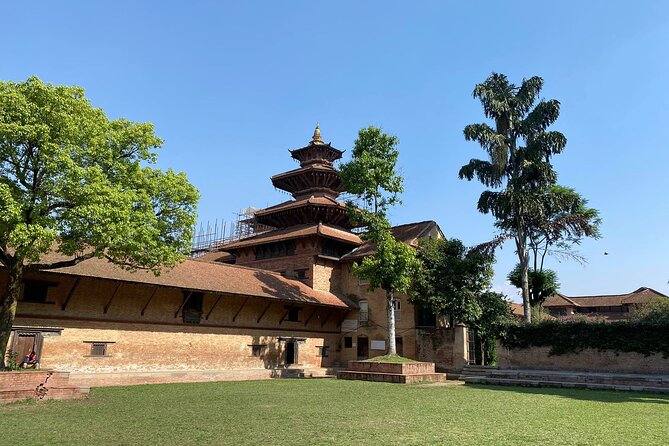
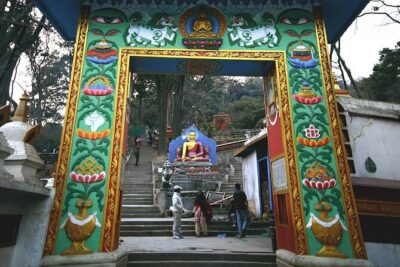
Your first stop is Swayambhunath, also called the Monkey Temple. The site is a UNESCO World Heritage place with a large stupa, prayer flags, and many smaller shrines. It is both a major religious center and one of Kathmandu’s best viewpoints.
The hilltop setting gives Swayambhunath its character. From here, you can look across the Kathmandu Valley, with the view changing according to the light and weather. The tour description points to sunrise and sunset as especially attractive times, although your exact tour time depends on the flexible schedule arranged for your group.
The guide can explain the stupa’s Buddhist symbolism and the local legends tied to the site. This is where a guide earns the fee. The painted eyes, layered design, prayer flags, and surrounding shrines are not random decoration. Their meaning becomes easier to follow when someone explains what you are seeing in plain language.
The monkeys add an entertaining, slightly unruly note. You may see them moving around the temple area, which helps explain the familiar nickname. I would enjoy the chance to observe them, but I would also keep your attention on the religious setting. This is a sacred place first, not a wildlife stop.
The two-hour allocation gives you time to do more than take a quick photograph. You can listen to the guide, take in the valley, notice the prayer flags, and look at the shrines around the main stupa. If you are interested in Buddhist culture, this is the part of the tour that creates the broadest sense of place.
There is one practical concern. The site sits on a hill, and the information provided specifically cautions that physically ill people may not be suitable for the activity. Most people can participate, but you should consider your health and comfort before choosing a hilltop temple visit.
The admission information needs a little care. Swayambhunath is described with free admission in the stop details, while the general tour information says entrance fees are not included and estimates them at about $4. I would set aside the extra amount rather than assume every site cost is covered.
Boudhanath: the spiritual center of the second half
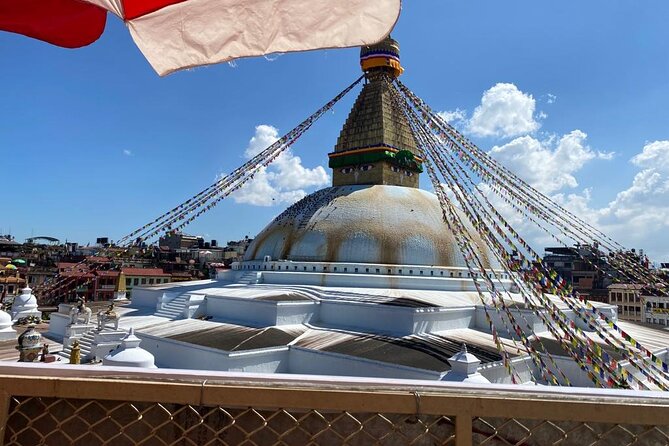
After Swayambhunath, the tour continues to Boudhanath Stupa. Boudhanath is one of Nepal’s most important Buddhist sites and one of the world’s largest stupas. Its huge dome, prayer flags, mandala details, and surrounding religious buildings create a powerful visual center.
The experience here is less about a distant viewpoint and more about movement around the stupa. You can walk around the dome, spin prayer wheels, and observe monks in meditation. You may also light butter lamps, one of the cultural practices included in the tour’s focus.
These actions are simple, but they make the visit more personal. Spinning a prayer wheel or lighting a lamp is not the same as watching a ceremony from behind a barrier. The guide can help you understand the respectful way to take part and explain why these practices matter.
Boudhanath also gives you a look at daily life around a sacred site. The area includes shops, markets, and cafes, so you can see how religious activity and ordinary business share the same space. The atmosphere is lively, but the center of the stupa remains calm and focused.
The architecture deserves time. Look at the large dome, the mandala patterns, the prayer flags, and the details around the main structure. An expert guide can explain the stupa’s importance in Tibetan Buddhism and its historical roots, giving you a stronger sense of why this place attracts both worshippers and sightseers.
The advertised schedule allows about two hours here. That is enough for a guided walk around the stupa and some quiet observation. It may feel brief if you want to shop, eat, ask many questions, and spend a long time watching the monks. The tour is best understood as an introduction rather than a full day devoted to Boudhanath.
Food and drinks are not included. You can purchase them during the outing, with an approximate additional cost of $15. The nearby cafes and food options make a stop possible, but you should treat it as an optional expense, not part of the $85 price.
What the guide adds to the visit
This is not simply private transport between two monuments. The guide is meant to interpret what you see. At Swayambhunath, that means Buddhist symbols, local legends, prayer flags, shrines, and the meaning behind the stupa. At Boudhanath, it means Tibetan Buddhist traditions, architecture, mandalas, prayer wheels, and the role of the site in local religious life.
I value that human explanation because religious sites can be easy to misread. A photograph may capture the white dome or a line of prayer flags, but it will not tell you why people walk around the stupa, why butter lamps are lit, or how the site connects to Buddhist practice.
You also have room to ask questions. Since the tour is private, your group is the only group participating. That makes the outing a better fit if you want to focus on Buddhist culture rather than follow a fixed speech aimed at a large crowd.
The guide is described as government-licensed and English-speaking. No individual guide’s name is provided, so I cannot judge a particular person’s style. Still, the structure of the tour gives the guide a useful role: explaining the sites while allowing you to see them at a comfortable pace.
A short list of alternatives around Kathmandu
- Everest Base Camp Trek – 14 Days
★ 5.0 · 1,499 reviews - Private Kathmandu Sightseeing Tour | UNESCO World Heritage sites
★ 5.0 · 756 reviews - Everest Base Camp Helicopter Tour landing at Everest View Hotel
★ 5.0 · 668 reviews - Half day cooking class in Thamel kathmandu
★ 5.0 · 607 reviews
Private transport and timing in Kathmandu
Hotel pickup and drop-off are included, along with round-trip travel by private car. This is one of the strongest practical features. Kathmandu traffic can make short distances feel long, and having transport arranged saves you from negotiating each transfer on your own.
The private setup also helps if you are traveling with family or a small group. You do not need to wait for strangers, and the schedule can be flexible around your interests. Group discounts are available, though the exact discount is not stated, so ask for the current group price before booking.
The tour lasts about four hours, with roughly two hours at each stop. That makes it easy to fit into a morning or afternoon. The timing is long enough to offer real context at both sites, but short enough to combine with other Kathmandu plans.
If you want the best possible light for the valley view, ask about timing before the day begins. The information specifically points to sunrise and sunset at Swayambhunath. A flexible schedule may help, but the tour’s available start times and your hotel pickup time will determine what is possible.
Is $85 a fair price?
The price is $85 per person. That may seem high for a four-hour outing, especially because entrance fees, food, and drinks are extra. The approximate additional costs are $4 for entrance fees and $15 for food and drinks, although you do not have to spend the full food estimate.
The value comes from what is bundled into the rate. You receive hotel pickup and drop-off, private round-trip transport, a private tour, a licensed English-speaking guide, flexible timing, and bottled water. If you would otherwise arrange a car and hire a guide separately, the price becomes easier to justify.
The tour also saves planning time. You do not need to work out the order of the sites, arrange transport, or research the meaning of the religious details before you arrive. For a first visit to Kathmandu, that convenience can be worth paying for.
It is less attractive if you are comfortable using local transport, prefer to explore independently, or have already visited both sites. In that case, $85 per person may buy more structure than you need. The private format is the key value, not the admission itself.
Who should book this tour?
I would recommend it most strongly to a first-time visitor with only a few hours available. You receive a compact introduction to two of Kathmandu’s most important Buddhist places without spending the day organizing transport.
It also suits you if Buddhist culture is a main reason for visiting Nepal. The chance to observe monks, light butter lamps, spin prayer wheels, and ask a guide about ritual practice gives the tour more substance than a standard photo stop.
Families and small groups may appreciate the private car and flexible schedule. A group discount could improve the value, though you should confirm the amount before booking.
I would be more cautious if you have serious physical limitations or are feeling unwell. Swayambhunath’s hilltop setting may make the outing tiring. The tour information says most people can participate, but it also specifically notes physically ill people as a concern.
Food lovers can also add a small local treat around town. One useful tip from the available feedback is to try momo, Nepalese dumplings, at a local food spot. That is not included in the tour, but it offers an easy way to extend the cultural experience after the temples.
Booking, cancellation, and practical details
You receive confirmation at the time of booking, and a mobile ticket is available. Hotel pickup and drop-off are included, but you should provide accurate hotel details so the transfer can be arranged properly.
Free cancellation is available if you cancel at least 24 hours before the start time. If you cancel later, the amount paid is not refunded, and changes made within that 24-hour period are not accepted. The cut-off follows Kathmandu local time.
Bring a little extra money for entrance fees and optional food or drinks. A bottle of mineral water is supplied for each person, but the tour does not include meals.
Should you book the Swayambhunath and Boudhanath tour?
Book it if you want a private, guided introduction to Kathmandu’s Buddhist culture and value having transport handled for you. The strongest features are the pairing of two very different sacred sites, the guide’s explanations, the chance to take part in simple rituals, and the freedom of a private schedule.
Skip it if you are watching every dollar, prefer independent sightseeing, or have already explored both stupas. For everyone else, the $85 cost is reasonable when you count the car, guide, hotel transfers, and four hours of focused attention. Just budget for extra fees, ask about the timing you want, and be realistic about the hill at Swayambhunath.
FAQ
How long does the Swayambhunath and Boudhanath tour last?
The tour lasts approximately four hours. About two hours are allocated to Swayambhunath and about two hours to Boudhanath Stupa.
What is the price of the tour?
The price is $85 per person.
Is hotel pickup included?
Yes. Hotel pickup and drop-off are included in the tour.
Is transportation private?
Yes. The tour includes round-trip transportation by private car, and only your group participates.
Is the guide included?
Yes. A government-licensed English-speaking tour guide is included.
Are entrance fees included?
No. Entrance fees are not included, and the estimated cost is about $4. The stop information describes Swayambhunath admission as free, so you should confirm the applicable fee when booking.
Are food and drinks included?
No. Food and drinks are available to purchase, with an approximate cost of $15.
Is bottled water provided?
Yes. Each person receives one bottle of mineral water.
Can I cancel for a full refund?
Yes, if you cancel at least 24 hours before the experience start time. Cancellations made less than 24 hours in advance are not refunded.
Is this a group tour?
No. It is a private tour, and only your own group participates. Group discounts are offered, but the exact discount is not specified.
New in the Kathmandu listings
- Traditional Momo Making Class★ 5.0 · 10 reviews
- Kathmandu: Ancient City Kirtipur & Pharping Monastery Tour★ 5.0 · 2 reviews
- Kathmandu to Pokhara Premium sofa bus ticket★ 4.0 · 17 reviews
- Women Empowerment Project(Nepali cooking class & jewelry workshop★ 5.0 · 15 reviews
- 7-Day Langtang Valley Trek from Kathmandu★ 5.0 · 1 review
- Kathmandu 2 Nights 3 Days Chitwan Jungle Safari Tour★ 5.0 · 9 reviews
- Yoga Experience Day Trip with Private Transfer From Kathmandu★ 4.0 · 2 reviews
- Wildlife Adventure in Chitwan Nepal★ 4.0 · 4 reviews
Swayambhunath Monkey Temple Tours, compared.
Monkey Temple – Swayambhunath Tour – Private/Small Group
Read our review →
Chandragiri Cable Car & Monkey Temple Tour- Private/Group
Read our review →
Private Chandragiri Cable Car and The Monkey Temple Tour
Read our review →
Kathmandu Chandrigiri Hill Cable Car & Monkey Temple UNESCO Tour
Read our review →
Chandragiri Cable Car Ride & Monkey Temple Tour – Private/Group
Read our review →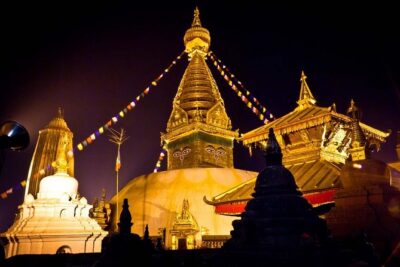
Private Half-Day Tour of Kathmandu Durbar Square and Swayambhunath Temple
Read our review →Browse the lists this tour appears in