
REVIEW · ANNAPURNA BASE CAMP TREKS
6 days Annapurna Basecamp Trek
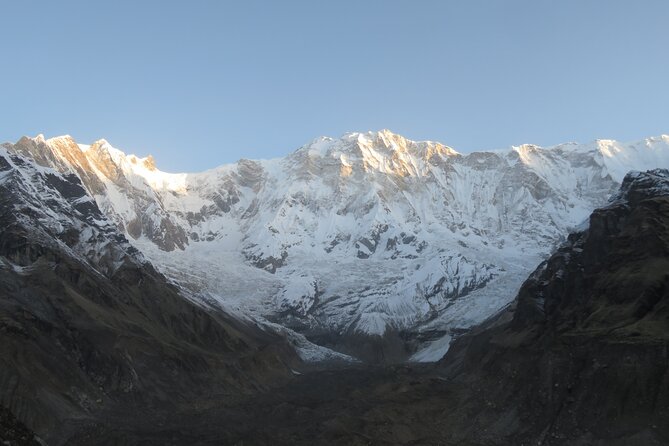
The Himalaya rewards steady feet. This six-day Annapurna Base Camp trek packs huge mountain views, Gurung villages, rhododendron woods, suspension bridges, and a sunrise at 8,091-meter Annapurna I into a short route from Pokhara. I like the small-group format, capped at 20 people, and the fact that private transportation, a licensed guide, five breakfasts, teahouse lodging, and trail equipment are included. The main caution is the pace: the days are listed at roughly 12 hours, so this is not a gentle sightseeing walk.
I also like the practical safety net. A guide is licensed, experienced, and insured, and duffle bags, sleeping bags, and anti-slip crampons are available as required. You should still budget for lunch, dinner, drinks, Wi-Fi, charging, toiletries, tips, and perhaps a porter at $30 per day.
In This Review
- Six things to know before you lace up
- Why this six-day route works from Pokhara
- Day one: Chhomrong, Gurung country, and the long bridge
- Day two: Entering the Annapurna Sanctuary
- Day three: Modi River, Dovan, and rhododendron forest
- Day four: The final approach to Annapurna Base Camp
- Day five: Sunrise over Annapurna I
- Day six: Returning to green valleys and civilization
- What the $450 price really covers
- The guiding and service style
- Who should book this trek?
- Practical costs, packing, and timing
- Should you book the six-day Annapurna Base Camp trek?
- FAQ
- How long does the Annapurna Base Camp trek last?
- What is included in the $450 price?
- Are lunch and dinner included?
- Is a porter available?
- How fit should I be for this trek?
- How large can the group be?
Six things to know before you lace up
- Annapurna I sunrise is the emotional high point: The mountain changes color as the first rays reach the snow.
- The route crosses a 285-meter suspension bridge: Jhinu Danda’s bridge hangs 135 meters above the Kimrong River.
- You walk through more than 30 rhododendron species: The forest section adds color and shade before the high, colder valley.
- Gurung villages give the trek a human scale: Chhomrong and the surrounding settlements are home to people known for their Gurkha military tradition.
- The price covers the useful basics: At $450 per person, you receive transport, guide service, teahouses, five breakfasts, and several pieces of trekking gear.
- The schedule favors speed over leisure: Six days is the attraction, but the long walking days demand moderate fitness and a good attitude.
Why this six-day route works from Pokhara
Annapurna Base Camp, often shortened to ABC, sits inside the Annapurna Sanctuary, a high mountain basin surrounded by snow peaks. This route reaches that basin in six days, making it appealing if you have limited time in Nepal or want to add other parts of the country afterward.
The route begins near Pokhara, Nepal’s main base for Himalayan walking. Pickup is offered, and private transportation is included, which matters because the first and final road sections can otherwise become a puzzle of local connections and changing vehicles.
The short schedule is both the route’s strength and its weakness. You get to the high point quickly, but you have less spare time if weather, tired legs, or trail delays interfere. The published days are around 12 hours, so I would treat the timing as a demanding target rather than a promise of a leisurely stroll.
The trip is capped at 20 people. That is not a private trek, but it is still a manageable maximum compared with a large coach-style outing. Group discounts may make the $450 rate more attractive for families or friends booking together.
More Annapurna Base Camp treks:
- Kathmandu/Pokhara: 5-Day Annapurna Base Camp (ABC) Trek
★ 4.9 · 72 reviews - Private 7 – Day Annapurna Base Camp Trekking
★ 5.0 · 50 reviews - Annapurna Base Camp Trek (8 days)
★ 5.0 · 45 reviews
Day one: Chhomrong, Gurung country, and the long bridge
The first day combines a substantial drive with the approach to Chhomrong, which sits at about 2,150 meters. The transport takes roughly three hours toward the Jhinu Danda suspension bridge, followed by walking through the foothills.
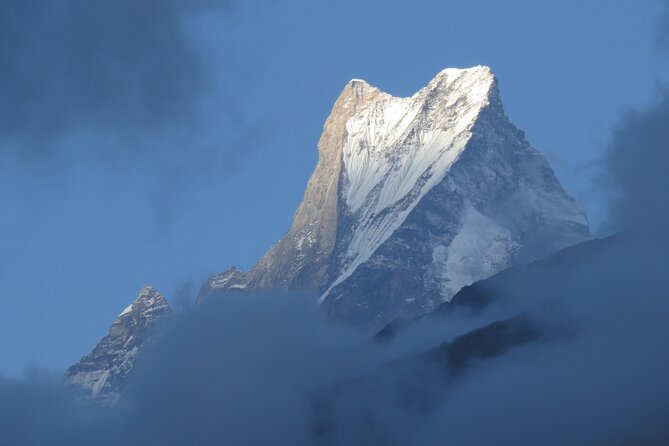
Chhomrong is important because it gives you one of the closest clear views of Annapurna South, which rises to 7,219 meters. Hiunchuli, at 6,441 meters, and the sharply recognizable Mt. Fishtail also enter the picture. This is your first proper introduction to the scale of the Annapurna range.
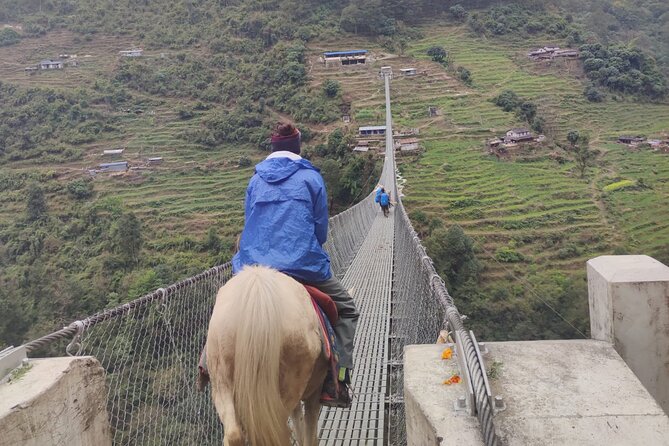
The Jhinu Danda bridge is a memorable piece of mountain infrastructure. At 285 meters long and 135 meters above the Kimrong River, it is not a tiny footbridge you cross without thought. The river below is clear, and the bridge provides the sort of thrilling, slightly wobbly moment that makes a Himalayan trek feel real.
The day is listed at 12 hours, so do not spend all your energy taking photographs at the first viewpoint. The villages and countryside are part of the experience, not merely scenery between major stops. You will see everyday foothill life, terraced slopes, and Gurung communities associated with the famous Gurkha soldiers.
Day two: Entering the Annapurna Sanctuary
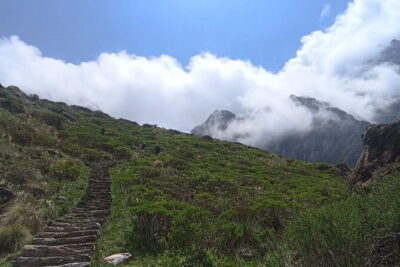
The second day begins with morning views of Annapurna South and Mt. Fishtail. From Chhomrong, the route descends and climbs repeatedly through the lower foothills before moving toward the Annapurna Sanctuary.
That up-and-down pattern matters. Many trekkers assume that a route leading higher must simply climb all day. Here, the repeated descents and climbs can be tiring because every lost meter must be regained. The guide’s pace and your water breaks will make a real difference.
This part of the walk also gives you a gradual change in surroundings. The open foothills begin to give way to a more enclosed mountain valley. The route follows the general direction of the Modi River, and the sense of entering a protected high basin grows as the peaks begin to feel closer on all sides.
Your accommodation is in teahouses. These are practical mountain lodgings rather than resort hotels. Breakfast is included each morning, but lunch and dinner are not, so keep money available for meals and drinks along the way. Bottled beverages, machine coffee, Wi-Fi, charging, and toiletries may also cost extra.
Day three: Modi River, Dovan, and rhododendron forest
The third day focuses on the Modi River valley and the approach to Dovan. Dovan lies in a basin between Hiunchuli and Mardi Himal, with the route gradually climbing upstream beside the river.
This is one of the most attractive parts of the trek for people who enjoy forests as much as high peaks. The path passes through thick rhododendron woodland, with more than 30 species found in the region. In season, the flowers add bright color to the trail. Even without blooms, the trees provide a welcome change from exposed stone and snow.
Clearings in the forest offer sudden views of the mountains. That alternating rhythm, enclosed path followed by a broad mountain view, is one reason this trek feels varied despite its short length.
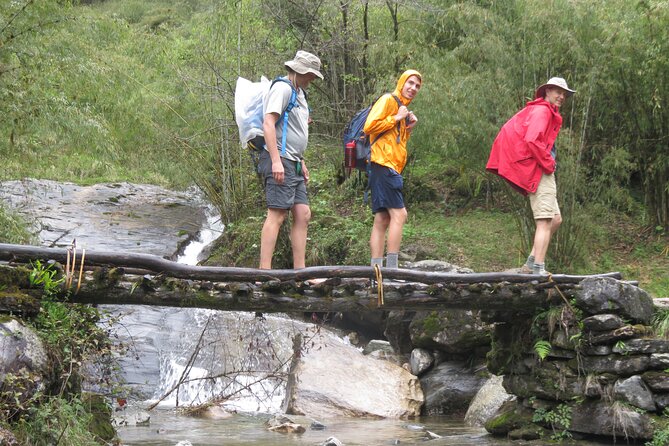
You should also expect streams, river crossings, and suspension bridges. These are not decorative additions to the route. They are part of how the trail works, and they require care when the surface is wet. Anti-slip crampons are available as needed, which is useful in icy conditions, though you should ask the guide when and where they will be used.
The combination of forest, river, and rising valley makes day three feel like the gateway to the high country. It is also another long day, listed at about 12 hours, so a moderate fitness level is the minimum sensible expectation.
More walking in the hills of Pokhara:
- Poon hill Trek 3 days
★ 5.0 · 176 reviews - Trekking in Annapurna/Langtang/Everest/Upper Mustang regions
★ 5.0 · 161 reviews - Pokhara: 4-Day Ghorepani, Poonhill & Ghandruk Mountain Trek
★ 5.0 · 132 reviews - Ghorepani – Poon Hill Trek 3N-4D
★ 5.0 · 125 reviews
Day four: The final approach to Annapurna Base Camp
The walk from Deurali to Annapurna Base Camp is the central mountain day. The route follows the Modi Khola upstream and enters a more open setting, with views of Mt. Fishtail, Annapurna III, Annapurna South, Annapurna I, and other peaks.
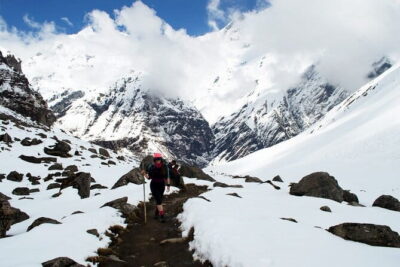
At this point, the scenery becomes more dramatic, but the conditions become less forgiving. The valley is colder, the air feels thinner, and the walking day remains long. You are no longer simply walking through pleasant foothills. You are moving into the high basin that gives the trek its name.
Annapurna I reaches 8,091 meters and is the tenth-highest mountain in the world. That statistic is interesting, but the more important fact is how the peak feels from the sanctuary. The mountains surround the basin rather than appearing as distant triangles on the horizon. The 360-degree view is the reward for the long approach.
The base camp itself is included in the tour’s admission arrangements, and the night is spent in teahouse accommodation. Keep your expectations practical. The value here is your position among the peaks, not luxury or a large menu of comforts.
Day five: Sunrise over Annapurna I
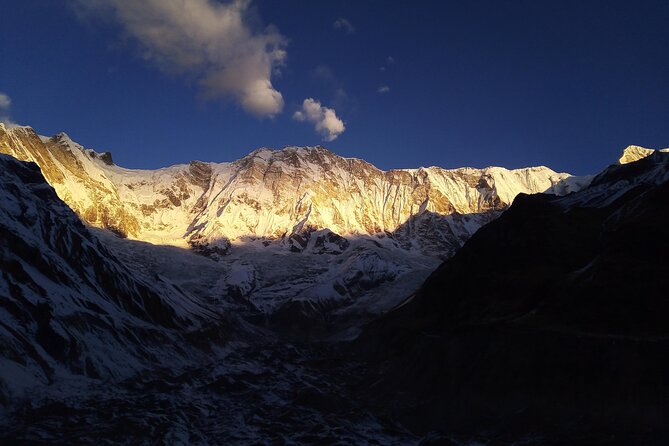
Day five is centered on the sunrise at Annapurna Base Camp. The early rays gradually reach the snow peaks, and Annapurna I changes color as the light strengthens.
This is the moment that justifies the demanding schedule for many people. I would keep your camera ready, but do not spend the entire sunrise staring at a screen. The view is broad, and the changing light moves quickly across Annapurna South, Annapurna III, Mt. Fishtail, and the surrounding summits.
The morning is described as easy after the sunrise, with time to enjoy the base camp area before beginning the return. That pause matters because it lets you appreciate where you are rather than treating the base camp as a quick photograph and a hurried departure.
The cold can be serious at this height, so the supplied sleeping bag may be useful. The anti-slip crampons are available if conditions call for them. Ask the guide about equipment before the early start, since fumbling with unfamiliar gear in the dark is not a fine way to begin a mountain morning.
Day six: Returning to green valleys and civilization
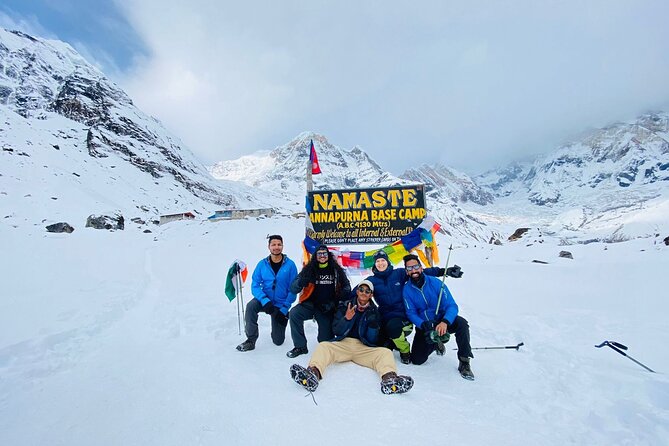
The final day brings a striking change. After several days in a cold, enclosed valley, you return toward greener foothills, villages, and the Modi River valley.
The route offers views across layers of hills, especially around breakfast, before the trail leads back toward civilization. This contrast is part of the pleasure of a mountain trek. The high basin feels remote and severe; the return feels warmer, greener, and more connected to ordinary life.
The sixth day is again listed at approximately 12 hours, so you should not assume that reaching the downhill section makes the day effortless. Descending can be hard on knees and ankles, particularly after the climb to base camp.
Private transportation is included, which should simplify the final transfer. Pickup is also offered at the start, giving the trip a clear structure from Pokhara to the trail and back again.
What the $450 price really covers
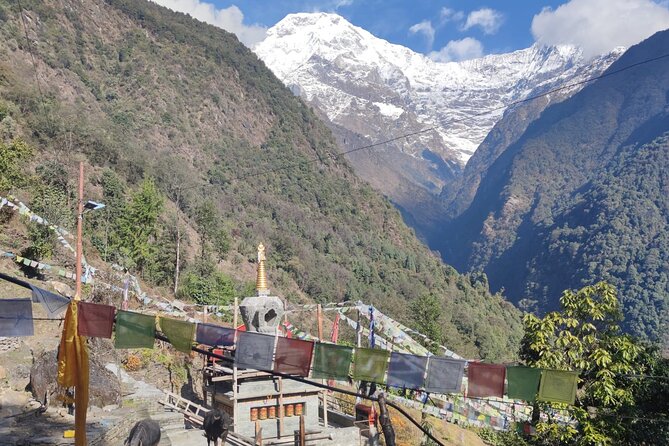
At $450 per person, this is not an all-inclusive trekking holiday. It is a guided mountain package with several important costs already handled.
Included are all fees and taxes, private transportation, five breakfasts, teahouse accommodation, a licensed and insured guide, and access to a duffle bag, sleeping bag, and anti-slip crampons when needed. Those inclusions reduce the amount of equipment you need to rent or arrange separately.
You pay for lunch and dinner as you go. You also pay for bottled drinks, machine coffee, toiletries, Wi-Fi, and charging where teahouses charge small extra fees. A porter is available for $30 per day, but that is separate from the advertised price.
Tips for the guide and porter are also not included. Service charges are included in hotels and restaurants, but that does not remove the need to plan for customary tipping.
The strongest value comes from the guide and transport. A licensed, insured guide is especially useful on a short route with long days, changing conditions, river crossings, and possible icy sections. Private transportation also saves you from arranging the road portions yourself.
The guiding and service style
The company behind the trek is iTour Nepal Private Day Tours. Its wider team has included guides such as Saroj and Ajaya, with porter support from people such as Samir. Saroj has been praised for patience, kindness, and good judgment, while Ajaya has been described as courteous and diligent.
You should confirm your exact guide and porter before departure, since the supplied information does not assign a named guide to every booking. Still, the strong theme around this operator is personal care, flexibility, and close attention to safety.
The company is family-run, and past arrangements have included customized combinations of trekking, cultural visits, Bandipur, Chitwan National Park, Upper Mustang, and Bhutan. That suggests a useful strength if you want to alter the trip or add time before or after ABC.
The group maximum of 20 allows the operator to accept mixed parties, but it also means the pace may not suit every person equally. Ask how the group will handle different walking speeds before you commit.
Who should book this trek?
I would recommend this trek to you if you have moderate fitness, limited time, and a strong desire to see a major Himalayan base camp without taking a longer route. It suits people who enjoy simple teahouses, early starts, mountain weather, and a clear physical challenge.
It is also a good fit if you want support without paying for a fully private luxury arrangement. The guide, transport, breakfast, lodging, and equipment access cover the parts that are hardest to organize independently.
I would be cautious if you want short walking days, private rooms, extensive meal choices, or lots of spare time for weather delays. The repeated 12-hour days are the biggest issue. Six days sounds efficient, but efficiency in the Himalaya often means less room for tired legs.
Solo participants can join, and the group setting may make the trek feel social. Couples, families with fit older teenagers, and small groups of friends can also benefit from the group discount. Anyone booking should honestly assess their ability to walk for long hours over uneven ground.
Practical costs, packing, and timing
Bring clothing for both warm foothills and cold high-altitude conditions. The operator provides access to a sleeping bag and crampons when needed, but you still need suitable walking clothes and personal essentials.
Pack light enough for the trail while leaving room for the items you must carry yourself. If you want a porter, arrange the $30-per-day service ahead of time rather than waiting until the walk begins.
Carry money for meals and small teahouse charges. Breakfast for five mornings is included, but the other meals are not. Charging and Wi-Fi may have small fees, and bottled drinks can add up over six days.
Booking demand is not instant, with this experience averaging around 40 days of advance booking. That is a useful planning clue, especially if your Nepal dates are fixed.
Confirmation arrives at booking. The tour is near public transportation, but the included pickup and private transport make the organized option more convenient. You can cancel for a full refund if you do so at least three full days before the local start time. Changes or cancellations inside that window are not accepted for a refund.
Should you book the six-day Annapurna Base Camp trek?
Book it if you want a fast, well-supported route to one of Nepal’s most impressive mountain basins and you are comfortable with long walking days. The best reasons are the sunrise over Annapurna I, the 360-degree mountain setting, the rhododendron forest, and the practical inclusion of transport, guide service, teahouses, breakfast, and equipment.
Think twice if your priority is a relaxed pace. The six-day schedule is the bargain and the burden. For a fit walker who values scenery, Gurung villages, rivers, bridges, and a strong high-mountain finish, $450 is a fair package price, provided you budget for meals, porter service, tips, and small teahouse expenses.
FAQ
How long does the Annapurna Base Camp trek last?
The experience lasts approximately six days. Each itinerary day is listed at about 12 hours, so you should prepare for a demanding schedule.
What is included in the $450 price?
The price includes all fees and taxes, private transportation, five breakfasts, teahouse accommodation, a licensed, experienced, and insured guide, plus a duffle bag, sleeping bag, and anti-slip crampons when required.
Are lunch and dinner included?
No. Lunch and dinner are not included. You also pay separately for bottled drinks, machine coffee, and possible teahouse charges for toiletries, Wi-Fi, and charging.
Is a porter available?
Yes. A porter can be added for $30 per day. Porter service is not included in the $450 price.
How fit should I be for this trek?
You should have a moderate level of physical fitness. The route includes long walking days, repeated climbs and descents, suspension bridges, streams, forest trails, and colder high-altitude sections.
How large can the group be?
The maximum group size is 20 people. Group discounts are offered, and pickup is available.
New in the Pokhara listings
- Pokhara: Pokhara Highlights Tour by Bus★ 3.6 · 10 reviews
- Discover Pokhara in Style: Private Vehicle Service with Driver★ 5.0 · 5 reviews
- Multi-Day Tour from Pokhara, Poon Hill and Mulde Trek★ 5.0 · 1 review
- Pokhara in 5 Hours: Lake, Museum, Cave, Falls & Pagoda Hill★ 4.5 · 16 reviews
- Private 4 Day Poon Hill Trek from Pokhara★ 5.0 · 16 reviews
- 4 Day Mardi Himal Base Camp Trek from Pokhara★ 5.0 · 18 reviews
- From Pokhara Full Day Entire Pokhara Tour with Guide★ 5.0 · 1 review
- Ultralight Flight: Into The Heart Of The Mountains (90 min)★ 5.0 · 1 review
Annapurna Base Camp Treks, compared.
Kathmandu to Annapurna Base Camp (ABC) 5-Day Trek
Read our review →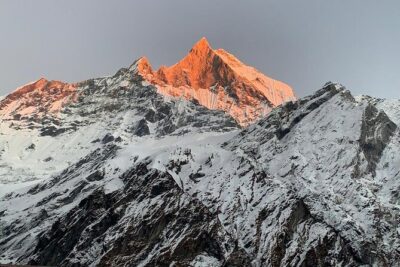
Kathmandu/Pokhara: 5-Day Annapurna Base Camp (ABC) Trek
Read our review →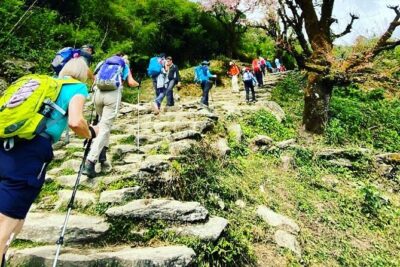
11-Day Hike Tour to Annapurna Base Camp Bliss in Kathmandu
Read our review →Browse the lists this tour appears in