
REVIEW · ANNAPURNA BASE CAMP TREKS
Annapurna Base Camp 7 Days Trek from Pokhara
Mountain country starts quickly. This seven-day trek packs forests, Gurung villages, suspension bridges, and high Himalayan views into a demanding route from Pokhara to Annapurna Base Camp. I like the wide range of scenery, from terraced hillsides and rhododendron woods to the snowy bowl of the Annapurna Sanctuary. I also like that the $435 price includes a guide, trekking permits, guesthouse stays, and road transfers.
The main consideration is the pace. Several days call for about six or seven hours of walking, and the route reaches 4,130 meters at Annapurna Base Camp. The schedule also describes the base camp on both Day 3 and Day 4, so I would confirm the exact overnight plan before paying. This is a private trek, but some road transfers use shared jeeps or buses.
In This Review
- The trek in a few useful facts
- Why this route works from Pokhara
- Day 1: Pokhara to Ghandruk by road
- Day 2: Ghandruk to Sinuwa through Chhomrong
- Day 3: Bamboo, Dovan, and the approach to the sanctuary
- Day 4: Machhapuchhre Base Camp and Annapurna Base Camp
- Day 5: Descending from base camp to Bamboo
- Day 6: Bamboo to Jhinu Danda
- Day 7: Jhinu Danda to Pokhara Lakeside
- What the $435 price gets you
- Guide support and the human side of the trek
- The main drawbacks to consider
- Who should book this trek
- Should you book the Annapurna Base Camp trek?
- FAQ
- How long is the Annapurna Base Camp trek from Pokhara?
- What is the highest point on the trek?
- Is hotel pickup and drop-off included?
- Is transportation included?
- Is a trekking guide included?
- Are trekking permits included?
- Is accommodation included?
- Is this a private tour?
- What happens if I cancel?
The trek in a few useful facts
- Gurung culture begins at Ghandruk: Explore one of the region’s major Gurung villages, with local customs, museums, and mountain views.
- The high point is 4,130 meters: Annapurna Base Camp sits inside a dramatic mountain sanctuary, surrounded by peaks including Annapurna I, Annapurna South, Hiunchuli, and Machhapuchare.
- Seven days means a brisk schedule: Walking days run from roughly five to seven hours, not counting meal and tea breaks.
- Guide and permits are included: The package covers an English-speaking guide, trekking permit, TIMS card, guesthouse accommodation, and transport.
- The route returns through Bamboo and Jhinu Danda: The descent offers a different rhythm, with forest trails, river crossings, and a final jeep ride to Pokhara.
- Guide service receives strong praise: Ram and Krishna are specifically praised for being helpful and supportive in the mountains.
Why this route works from Pokhara
Pokhara is the natural launch point for this trek. The city gives you a gentler start, with lakes, mountain views, and easy access to the road toward Nayapul and Birethati. From there, the route turns into the hills and heads toward the Annapurna region.
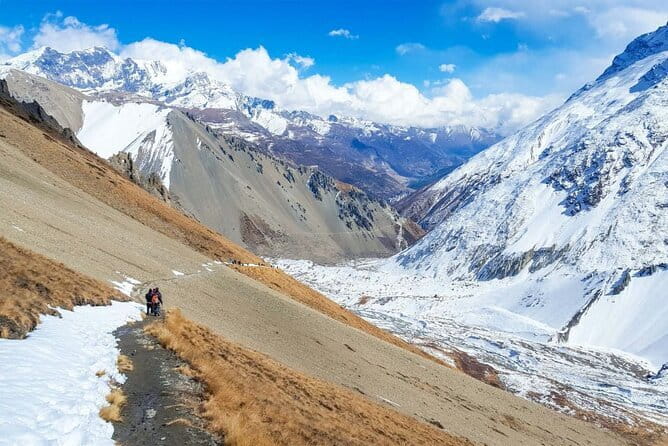
The trek is appealing because it changes character every day. You begin among cultivated hills and traditional villages, walk beneath thick forest, pass through river valleys, and finish among alpine meadows and glaciers. You do not get only one grand viewpoint at the end. The scenery keeps changing as you gain height.
The cultural side matters just as much. Ghandruk and Chhomrong are connected with Gurung communities, while other villages along the route show the practical rhythm of mountain life. You will see homes, trails, bridges, and small lodges that serve people moving through the valley. The route is not simply a march toward a famous sign. It is also a walk through inhabited mountain country.
More Annapurna Base Camp treks:
- Kathmandu/Pokhara: 5-Day Annapurna Base Camp (ABC) Trek
★ 4.9 · 72 reviews - Private 7 – Day Annapurna Base Camp Trekking
★ 5.0 · 50 reviews - Annapurna Base Camp Trek (8 days)
★ 5.0 · 45 reviews
Day 1: Pokhara to Ghandruk by road
The first day begins with pickup in Pokhara and a road journey through Nayapul and Birethati toward the Ghandruk area. The information provided describes a sharing jeep and an unpaved road, so expect a rougher ride than a standard city transfer. This is part of the adventure, but it can be tiring before the walking really begins.
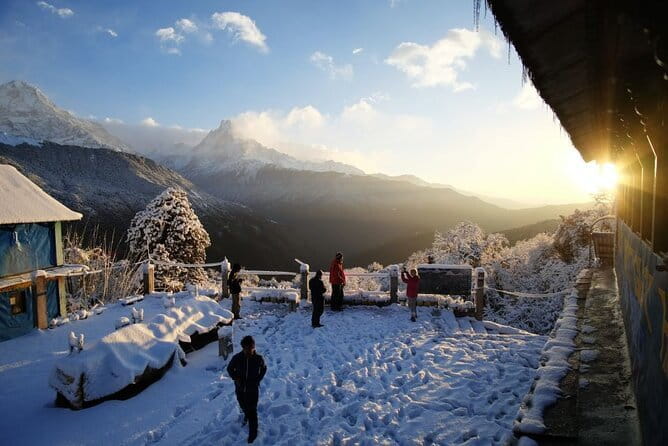
The route follows the Modi River and passes through villages and steep hills. At Ghandruk, you reach one of the best-known Gurung settlements in the Annapurna region. The village offers views of Annapurna South, Hiunchuli, Machhapuchare, Gangapurna, and Annapurna III.
Ghandruk is a strong first stop because it gives you both culture and scenery before the harder walking days. You can look around local museums, learn about Gurung customs, and see how the village is arranged on the hillside. The first day is listed at about seven hours, including the transfer and activities, though the exact walking time should be confirmed.
Day 2: Ghandruk to Sinuwa through Chhomrong
Day two is a serious walking day. The trail passes Kimrung Danda, the Kimrung River, and Chhomrong before reaching Sinuwa. The route rises and falls, so the distance alone does not tell the whole story. Short climbs can feel demanding after the previous day’s road journey.
Chhomrong is an important point on the approach to Annapurna Base Camp. From here, the valley narrows and the route begins to feel more remote. You continue through changing vegetation, with Gurung culture still visible in the villages and the Annapurna peaks appearing between hills and trees.
The day is listed at around seven hours, excluding lunch and tea breaks. You should treat that as a full day outdoors, not a casual morning walk. A steady pace will serve you better than rushing early and struggling later.
Sinuwa is a useful overnight point because it places you farther inside the valley while keeping you among the forest zone. The route is already beautiful here, but the most dramatic mountain setting comes later.
Day 3: Bamboo, Dovan, and the approach to the sanctuary
The supplied schedule labels Day 3 as Annapurna Base Camp, but its description focuses on the trail through Bamboo, Dovan, and the Modi River valley. Day four then describes the climb from Machhapuchhre Base Camp to Annapurna Base Camp. I would ask the provider to confirm the intended overnight locations, since the practical route normally requires a clear approach day before the base camp day.
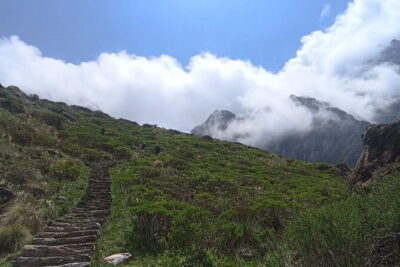
The section through Bamboo and rhododendron forest is one of the route’s most appealing parts. The trail follows the Modi River and moves through a cooler, more enclosed setting. Bamboo, Dovan, and the surrounding forest give you a sense of entering the Annapurna Sanctuary.
This is also where the air begins to feel different. You are walking higher, the forest changes, and the trail becomes more focused on the valley leading toward the mountain bowl. The schedule allows about seven hours, so you should expect a demanding approach rather than a short scenic stroll.
The forest is a welcome contrast to the open views around Ghandruk. You may not see the full mountain range at every step, but the wooded trail, river valley, and changing vegetation keep the walk interesting.
More walking in the hills of Pokhara:
- Poon hill Trek 3 days
★ 5.0 · 176 reviews - Trekking in Annapurna/Langtang/Everest/Upper Mustang regions
★ 5.0 · 161 reviews - Pokhara: 4-Day Ghorepani, Poonhill & Ghandruk Mountain Trek
★ 5.0 · 132 reviews - Ghorepani – Poon Hill Trek 3N-4D
★ 5.0 · 125 reviews
Day 4: Machhapuchhre Base Camp and Annapurna Base Camp
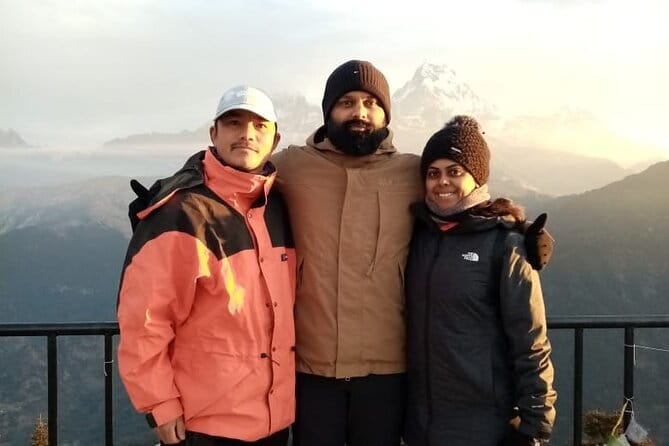
This is the emotional center of the trek. The route climbs toward Machhapuchhre Base Camp at about 3,900 meters, then continues into the Annapurna Sanctuary and up to Annapurna Base Camp at 4,130 meters.
The climb is described as roughly 730 meters from the Machhapuchhre Base Camp area to Annapurna Base Camp. At this altitude, a gradual pace matters. The air is cooler and thinner, and a climb that might feel easy lower down can require real effort here.
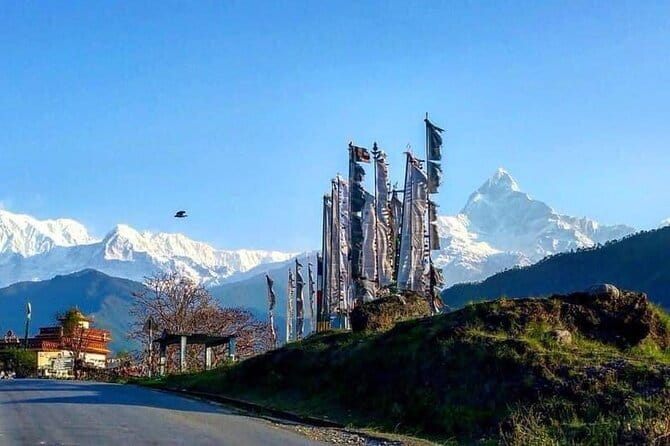
Machhapuchhre, also called Fishtail, is the star of the approach. The stop beneath its North Face gives you a close look at one of Nepal’s most recognizable peaks. From there, the trail continues across grassy higher ground into the sanctuary.
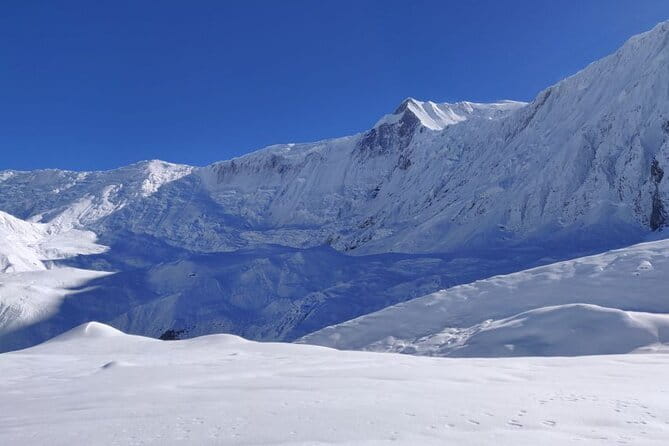
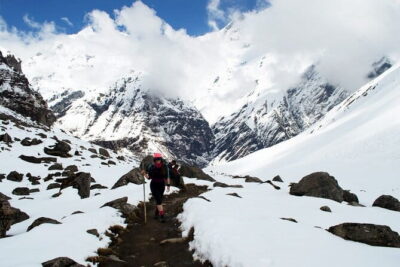
At base camp, the mountains form a huge circle around the valley. Annapurna I is among the key peaks visible from the sanctuary, along with Annapurna South, Hiunchuli, and other major summits. The setting feels enclosed and grand at the same time. You are not merely looking at distant snow peaks. You are standing inside a mountain amphitheater.
The day is listed at about six hours. That may sound shorter than the earlier walking days, but altitude makes the hours count differently. You should focus on steady movement, warm layers, water, and listening to your guide.
Day 5: Descending from base camp to Bamboo
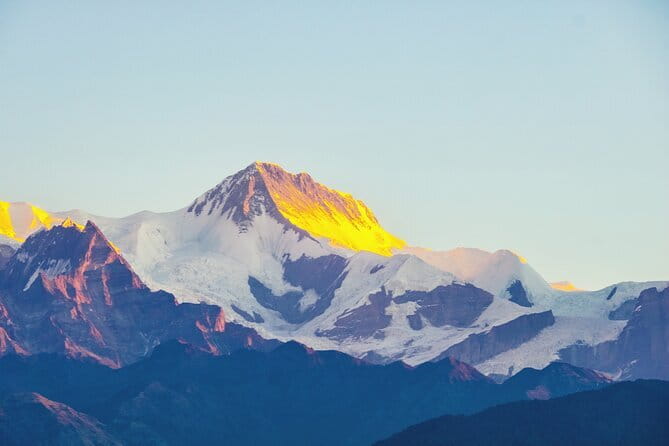
After the high point, the route turns back toward the forests. The descent passes through Deurali, Himalaya, Dovan, and finally Bamboo. It is listed at roughly six hours.
Downhill walking is often easier on the lungs but harder on the knees. The trail can be uneven, and the advice to walk carefully is worth taking seriously. Trekking poles, if you use them, can help with balance, though they are not listed as included.
The scenery changes quickly as you lose height. You return from the open high country to the forest and tree line. Bamboo makes sense as an overnight stop because it brings you back into a warmer, greener setting after the exposed base camp area.
A hot shower is specifically mentioned at Bamboo. After the cold and exertion of the upper route, that small comfort can feel like a major luxury. Guesthouse accommodation is included, but personal expenses are not, so confirm which shower or lodge charges may apply.
Day 6: Bamboo to Jhinu Danda
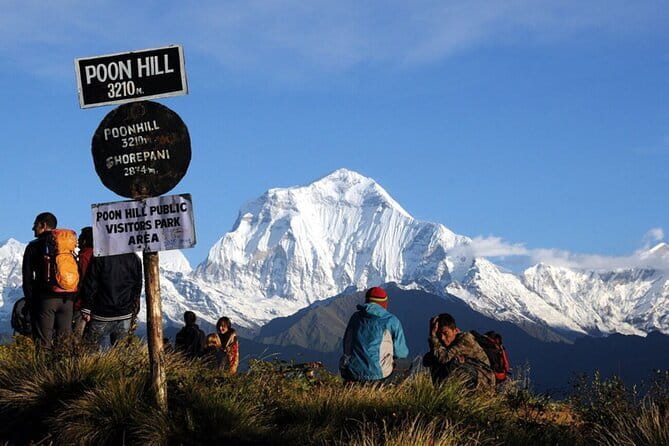
Day six mixes climbs and descents. You first make a short, steep climb toward Khuldi Ghar, then descend through forest toward Sinuwa Danda. From there, the route drops to the Chomrong Khola.
After crossing the bridge, you climb again toward Chomrong for lunch. The trail then rises briefly to the top of the Chomrong ridge before descending to Jhinu Danda. The day is about six hours.
This is a good reminder that a return route is not one long downhill walk. The hills continue to roll, and the bridge crossings do not remove the need for more climbing. You should keep some energy in reserve for the final ridge and descent.
Jhinu Danda is the last overnight stop listed. It gives you a final mountain-village setting before the road return to Pokhara. The route here is a mix of forest, river scenery, and settlement, with a more relaxed feeling than the high-altitude section.
Day 7: Jhinu Danda to Pokhara Lakeside
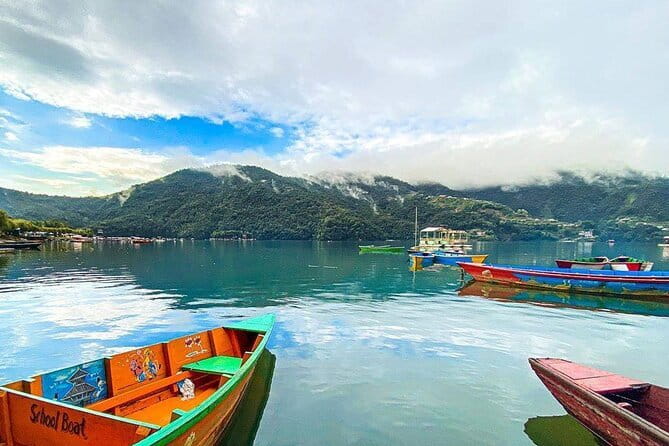
The final walking section is short by comparison. You descend and cross a long suspension bridge to Samrung Khola, where you catch a local jeep toward Pokhara.
The drive takes about four hours and passes through Kimrung village, Syauli Bazaar, Birethati, Nayapul, Kande, and Naudanda before reaching Pokhara Lakeside. Road conditions and traffic can affect the timing, especially since the transfer is by local jeep.
This last day is practical rather than scenic in the same way as base camp day. Still, the road traces the route back through the hill communities and gives you time to look back on the walk. The tour ends in Pokhara.
What the $435 price gets you
At $435 per person, the value depends on what you would otherwise need to arrange separately. The price includes:
- Hotel pickup and drop-off
- Round-trip transport by sharing bus or jeep
- Trekking permit and TIMS card
- English-speaking trekking guide
- Guesthouse accommodation
- A private trip for your group
That is a useful package for anyone who does not want to arrange permits, transport, and guide service independently. It also reduces the chance of arriving at the trailhead without the correct paperwork.
There are two details to clarify. First, the trip is described as private, but road transfers may be shared. That usually means your trekking group has its own guide and arrangement, while some vehicle legs are shared with other passengers. Second, food and personal costs are not listed among the inclusions. You should budget for meals, drinks, snacks, hot showers, and gratuity.
The price is strongest for people who value simplicity. You pay more than you might for a completely independent trek, but you gain a guide, permits, accommodation arrangements, and transport from Pokhara.
Guide support and the human side of the trek
The guide can make a major difference on a route with long days and rising altitude. The strongest praise is directed at Ram and Krishna, both described as helpful, friendly, and supportive. Krishna is also singled out as an excellent mountain guide after completing the full ABC route.
That feedback points to the service most worth valuing here: dependable support on the trail. You should still ask who your assigned guide will be, since the specific guide may depend on availability.
The tour is private, so only your group participates in the trekking activity. That gives you more control than a large group departure. You can discuss pace and rest stops with your guide, though the seven-day schedule still places limits on how slowly you can move.
The main drawbacks to consider
This trek is not an easy mountain holiday. The stated physical requirement is moderate fitness, but seven hours of walking on steep and uneven trails is a real commitment. The climb to 4,130 meters adds another challenge.
The itinerary wording needs clarification. Annapurna Base Camp appears as the stop on both Day 3 and Day 4, while the detailed descriptions suggest that Day 3 is the approach through Bamboo and Dovan, followed by the base camp climb on Day 4. Ask for the confirmed lodges and daily walking times.
The road transfers also deserve realistic expectations. You will use sharing buses or jeeps, and at least part of the road is unpaved. That keeps the cost down, but it may not feel smooth or predictable.
Finally, gratuity is not included. Personal expenses are also separate. Set aside money for both rather than treating the advertised price as the entire trip budget.
Who should book this trek
I would recommend this trek to you if you want a compact route from Pokhara to a major Himalayan base camp and are comfortable with long walking days. It suits people who want scenery, Gurung villages, forest trails, and a clear mountain goal in one trip.
It is especially useful if you want a guide and permits arranged in advance. The private format is a good fit for couples, families with strong hiking ability, or small groups that prefer their own trekking arrangement.
I would be cautious if you dislike rough road transfers, need a slow itinerary, or have limited hiking fitness. The route is not suitable for wheelchair users because it requires sustained walking on mountain trails.
Bring a passport copy and passport-size photo before the trek. These are required for the trekking permit. Also confirm the exact route plan, meals, luggage arrangements, and guide assignment before departure.
Should you book the Annapurna Base Camp trek?
Book it if the combination of high mountain views, village life, and organized logistics appeals to you. The package covers the expensive and inconvenient basics, and the guide service receives particularly strong praise from people who used Ram and Krishna.
I would book only after confirming the Day 3 and Day 4 schedule. Once that detail is clear, the trek offers good value at $435 for a private seven-day arrangement with transport, permits, accommodation, and a guide. It is a brisk adventure, not a gentle walk, but the reward is the Annapurna Sanctuary and one of Nepal’s most memorable mountain settings.
FAQ
How long is the Annapurna Base Camp trek from Pokhara?
The experience lasts approximately seven days, including road transfers from Pokhara and the return to Pokhara Lakeside.
What is the highest point on the trek?
The highest point is Annapurna Base Camp at 4,130 meters above sea level.
Is hotel pickup and drop-off included?
Yes. Hotel pickup and drop-off are included in the package.
Is transportation included?
Yes. Round-trip transport by sharing bus or jeep is included. The final drive from Samrung Khola to Pokhara takes about four hours.
Is a trekking guide included?
Yes. An English-speaking trekking guide is included. Guide names associated with the experience include Ram and Krishna.
Are trekking permits included?
Yes. The package includes a trekking permit and TIMS card. A passport copy and passport-size photo are required before the trek.
Is accommodation included?
Yes. Accommodation in guesthouses is included during the trek.
Is this a private tour?
Yes. It is described as a private tour or activity, with only your group participating. Some road transfers may use shared vehicles.
What happens if I cancel?
You can receive a full refund if you cancel at least 24 hours before the experience start time. Cancellations or changes made less than 24 hours before the start time are not accepted for a refund.
New in the Pokhara listings
- Pokhara: Pokhara Highlights Tour by Bus★ 3.6 · 10 reviews
- Discover Pokhara in Style: Private Vehicle Service with Driver★ 5.0 · 5 reviews
- Multi-Day Tour from Pokhara, Poon Hill and Mulde Trek★ 5.0 · 1 review
- Pokhara in 5 Hours: Lake, Museum, Cave, Falls & Pagoda Hill★ 4.5 · 16 reviews
- Private 4 Day Poon Hill Trek from Pokhara★ 5.0 · 16 reviews
- 4 Day Mardi Himal Base Camp Trek from Pokhara★ 5.0 · 18 reviews
- From Pokhara Full Day Entire Pokhara Tour with Guide★ 5.0 · 1 review
- Ultralight Flight: Into The Heart Of The Mountains (90 min)★ 5.0 · 1 review
Annapurna Base Camp Treks, compared.
Kathmandu to Annapurna Base Camp (ABC) 5-Day Trek
Read our review →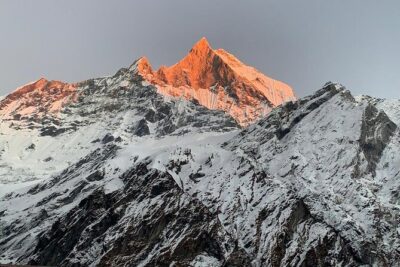
Kathmandu/Pokhara: 5-Day Annapurna Base Camp (ABC) Trek
Read our review →
11-Day Hike Tour to Annapurna Base Camp Bliss in Kathmandu
Read our review →Browse the lists this tour appears in