
REVIEW · UNESCO WORLD HERITAGE TOURS
UNESCO Seven World Heritage Tour in Kathmandu
Kathmandu’s greatest sights demand a full day. This private tour links all seven UNESCO-listed heritage areas across the valley, from the hilltop prayer flags of Swayambhunath to the carved courtyards of Bhaktapur and the sacred riverside complex of Pashupatinath. I especially like the private car, which saves time on Kathmandu’s crowded roads, and the guides, including Shanti, Pankaj, Kabita, and Sarita, who are praised for explaining both Hindu and Buddhist traditions clearly. The main drawback is simple: twelve hours is a lot of sightseeing, walking, stairs, temples, and information in one stretch.
I also like that entry fees for the seven heritage sites, hotel pickup, hotel drop-off, a driver, and an English-speaking guide are included in the $180 price. You will not see every corner of Kathmandu at a slow pace, but you will get a strong first look at the valley and learn which places deserve a longer return visit.
In This Review
- Key points before you book
- Why this one-day plan works
- Swayambhunath and Amideva Buddha Park
- Kathmandu Durbar Square and the Kumari Courtyard
- Patan Durbar Square’s stone Krishna Temple
- Golden Temple and Patan Museum
- Bhaktapur, from Nyatapola to the Palace of Fifty-Five Windows
- Changu Narayan and the valley’s oldest temple tradition
- Pashupatinath and the Bagmati River
- Boudhanath and the final great stupa
- Guides, drivers, and the private-car advantage
- Is $180 a fair price?
- Who should book this Kathmandu heritage tour?
- Final verdict: book it for breadth, not slow sightseeing
- FAQ
- How long does the UNESCO Seven World Heritage Tour last?
- What is included in the price?
- Is lunch included?
- Is this a private tour?
- Which sites are visited?
- Do I need special clothing?
- Can I cancel for a full refund?
Key points before you book
- All seven UNESCO heritage areas in one day: This is built for a first visit or a short stay.
- Private transport saves time: Your group rides in a private vehicle rather than waiting for public transport.
- Changu Narayan adds the out-of-town stop: The hilltop temple is farther away and easy to miss on your own.
- Expect stairs and serious walking: Swayambhunath alone has 365 steps to the top.
- Guides shape the experience: Shanti, Pankaj, Kabita, Sarita, Som, and others are praised for patience, history, religion, and local advice.
- Lunch is not included: You choose and pay for lunch in Bhaktapur, where several eateries are available.
Why this one-day plan works
Kathmandu Valley’s major monuments are scattered across Kathmandu, Lalitpur, Bhaktapur, and the surrounding hills. Public transport can turn a short hop into a long wait, while traffic makes independent sightseeing harder than the map suggests.
This tour solves that problem with a private vehicle and a full-day route. You are picked up at your hotel and returned there afterward, with the driver handling the city traffic while your guide handles the cultural background.
The day typically begins early and runs for about twelve hours. Several people found the schedule surprisingly manageable because the guides adjusted the pace, allowed time for photos and shopping, and avoided forcing every stop into a rigid timetable. Still, you should expect a long day. One person ended early after about twelve hours, and another described the experience as an information overload, though a useful one.
That is the tradeoff. You gain breadth instead of lingering depth. I would use this tour to get your bearings, then return independently to one or two favorite sites if your schedule allows.
More UNESCO World Heritage Tours in Kathmandu:
- Private Kathmandu Sightseeing Tour | UNESCO World Heritage sites
★ 5.0 · 756 reviews - Kathmandu: Full Day 7 UNESCO Tour with Lunch – Private/Group
★ 5.0 · 415 reviews - Kathmandu: Full Day Top 4 UNESCO Tour with Lunch – Private/Group
★ 5.0 · 269 reviews
Swayambhunath and Amideva Buddha Park
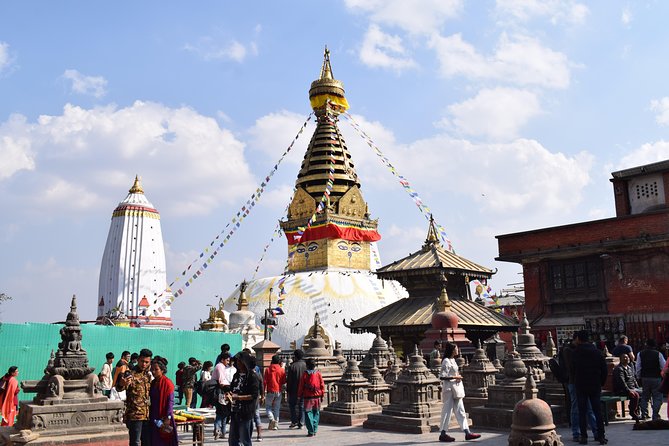
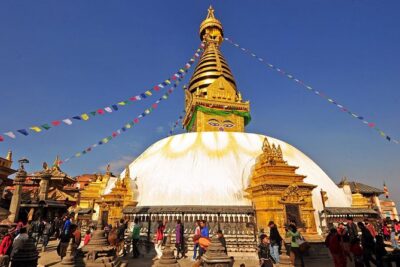
Swayambhunath, often called the Monkey Temple, sits on a hill above Kathmandu. The climb includes 365 stairs, so wear shoes with good grip and do not treat the opening stop as a gentle warm-up.
At the top, you circle the stupa, turn prayer wheels, and see Buddhist and Hindu shrines sharing the same sacred hill. That mix is one of the best introductions to Kathmandu’s religious life. The views over the city are another reward, although the climb and the amount of detail can make the first stop feel intense.
The listed visit allows about fifteen minutes at Swayambhunath, followed by roughly ten minutes at Amideva Buddha Park. That is enough for a quick look, photographs, and an explanation, but not enough for a quiet, unhurried visit to every shrine.
Amideva Buddha Park sits on the other side of the hill and is marked by three large Buddha statues. It is easy to overlook when visiting Swayambhunath alone, so including it gives the first stop a little more substance.
Kathmandu Durbar Square and the Kumari Courtyard
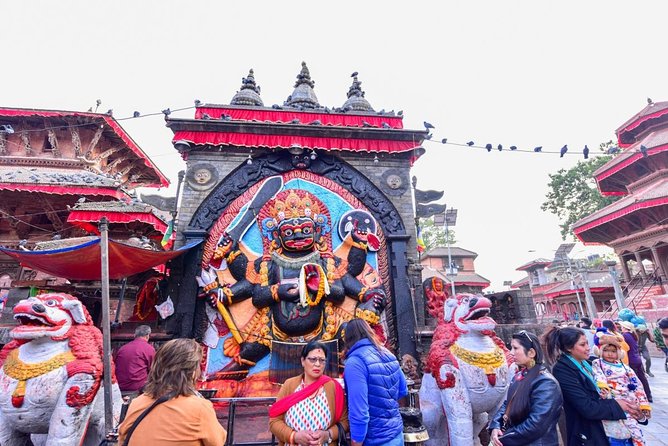
Kathmandu Durbar Square brings you into the old royal center of the capital. Earthquakes damaged several buildings, and reconstruction remains visible in parts of the square. That means you will see both restored structures and work still in progress, rather than a perfectly preserved historic stage set.
The nearby Kumari Chowk is a small but important stop. Inside this red-brick, three-level building is the courtyard associated with the Kumari, the living goddess chosen as a young girl and traditionally replaced when she reaches puberty.
The Kumari Chowk visit is listed at about ten minutes. Keep expectations realistic. This is a focused stop, not a long museum visit, and access to sacred spaces can be limited. Your guide is especially useful here, since the custom can be difficult to understand without context.
Patan Durbar Square’s stone Krishna Temple
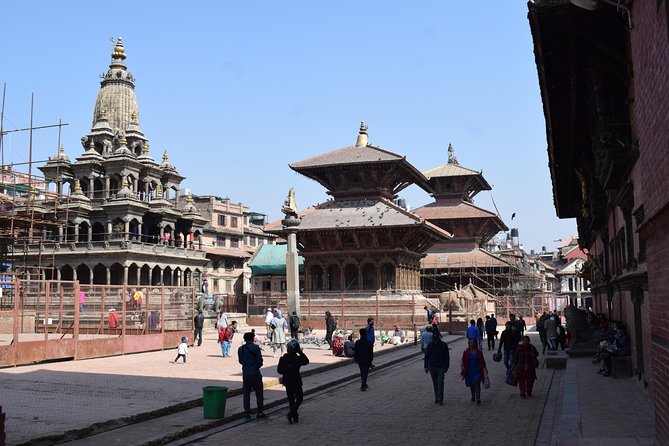
Patan, also called Lalitpur, is known for its Newar architecture and old palace square. The central Durbar Square is particularly strong for carved brick, timber details, courtyards, and stonework.
The Krishna Temple is the visual prize. Built entirely of stone, it has twenty-one shrines and a different look from the pagoda-style temples elsewhere in the valley. The tour allows about twenty-five minutes for the main square.
That is enough time to appreciate the layout and hear the story behind the major buildings. It is not enough to study every carving or spend a leisurely afternoon in the square. If Patan becomes your favorite stop, plan to return.
More history tours in Kathmandu:
- Kathmandu Private Sightseeing Tour | UNESCO World Heritage Sites
★ 5.0 · 109 reviews - Kathmandu: Full Day Private Top 4 UNESCO Heritage Tour W/Lunch.
★ 5.0 · 86 reviews - Kathmandu World Heritage Tour
★ 5.0 · 74 reviews - Nagarkot Sunrise & Bhaktapur UNESCO Heritage Private Tour
★ 5.0 · 66 reviews
Golden Temple and Patan Museum
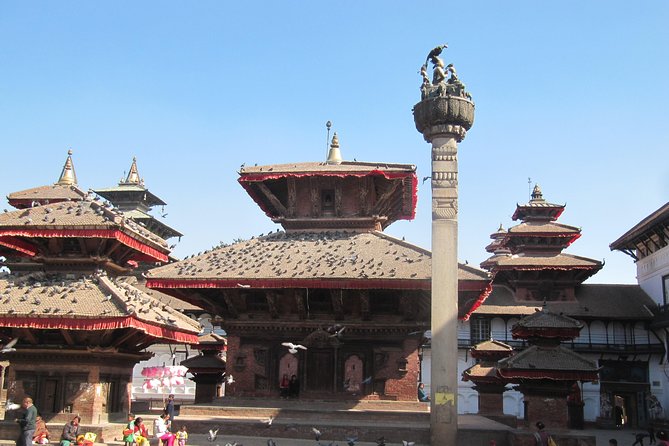
The Golden Temple, formally Hiranya Varna Mahavihar, is a twelfth-century pagoda-style Buddhist temple. Bronze statues, silver details, and the compact arrangement make it a good contrast to the broad palace squares.
The visit lasts about ten minutes. This is a place where a guide adds real value by explaining the temple’s role and pointing out details you could easily pass without noticing.
Next comes Patan Museum, located in Keshav Narayan Chowk. The museum focuses on Nepalese tradition and history, with special attention to religious art and old civilization. The schedule allows about fifteen minutes, so expect an introduction rather than a full museum visit.
I would pay attention to how the museum helps connect the objects to the temples outside. Without that link, the day can become a parade of beautiful buildings. With it, the carvings, statues, and symbols begin to make more sense.
Bhaktapur, from Nyatapola to the Palace of Fifty-Five Windows
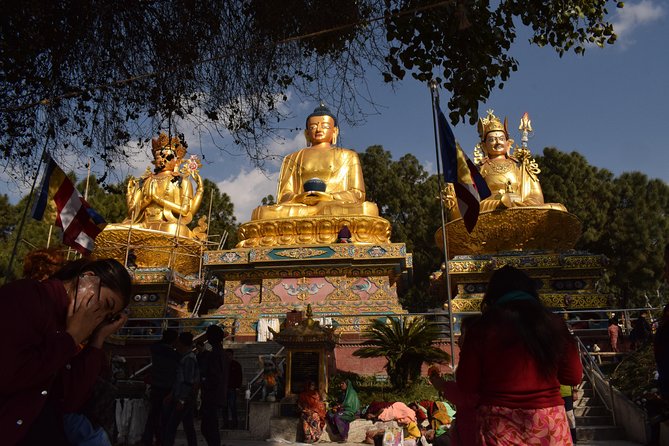
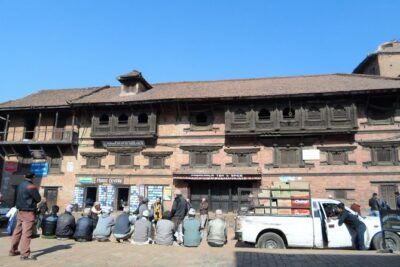
Bhaktapur is often the most rewarding part of the day because many traditional buildings remain intact. Its nickname, the City of Devotees, fits the temple squares, shrines, old houses, and religious activity you see while walking.
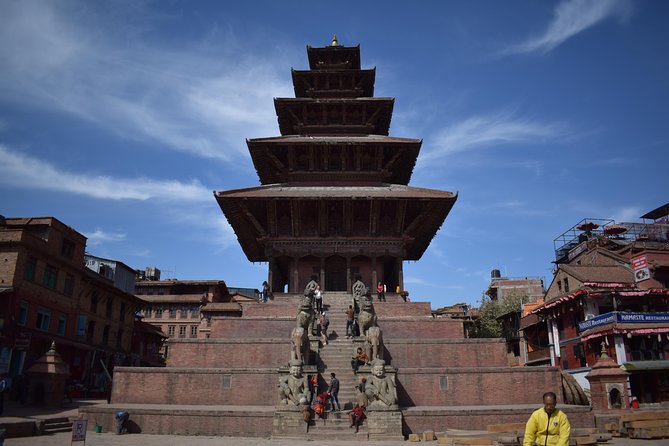
Nyatapola Temple is a five-level pagoda and one of the tallest traditional pagodas in Nepal. Its stairway and sculpted guardians make it an easy favorite for photographs. The planned stop is about ten minutes, but the surrounding square gives you plenty to notice as you move through it.
Dattatreya Temple sits in Dattatreya Square and is associated with the belief that it was made from a single tree. The temple’s unusual origin story is a reminder that many Kathmandu monuments carry mythology alongside their visible architecture.
The Palace of Fifty-Five Windows is one of Bhaktapur Durbar Square’s defining buildings. Its name comes from the fifty-five carved windows set into the palace facade. You have about ten minutes here, which is enough to take in the exterior and hear its place in the old royal complex.
Siddha Pokhari provides a short change of pace. This man-made pond near Bhaktapur’s first town gate is about 171 meters long and three meters deep. The scheduled visit lasts only five minutes, so think of it as a quick pause rather than a major sightseeing stop.
Lunch in Bhaktapur is not included, and that is useful in its own way. You can choose from several local eateries instead of being tied to a fixed restaurant. The exact cost and length of lunch are not set, so tell your guide early if you need a longer break.
Changu Narayan and the valley’s oldest temple tradition
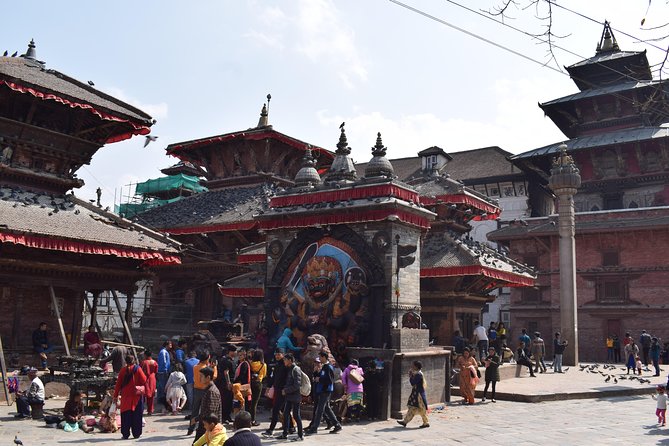
Changu Narayan is the most remote stop and one of the reasons the private car matters. The temple sits on a hilltop and dates back to the Licchavi period, making it one of the oldest temples in the Kathmandu Valley.
Its appeal comes from the stone and wood carvings, along with the quieter setting away from the central city. The tour allows about one hour here, giving you more breathing room than at some of the smaller stops.
The road time and hilltop location also make this one of the day’s more tiring sections. If you have already spent the morning climbing stairs and walking across squares, the hour may feel welcome, but the full route can still wear you down.
Pashupatinath and the Bagmati River
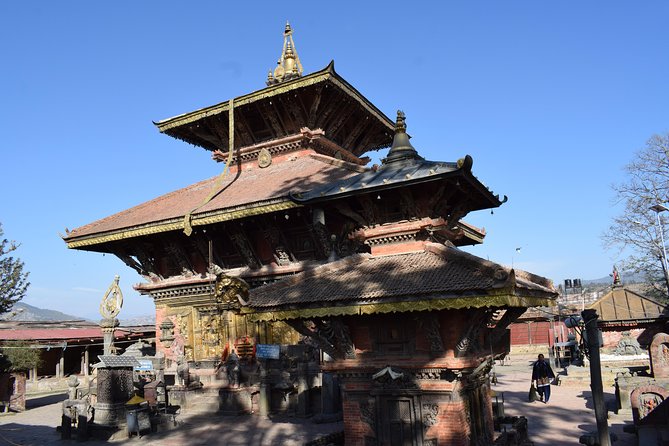
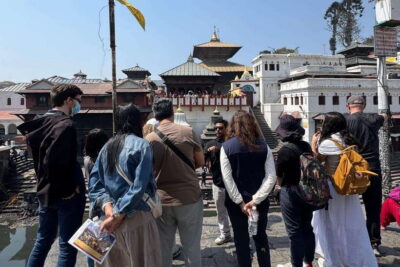
Pashupatinath is one of Nepal’s largest temple complexes, covering about 0.64 hectares and containing more than 500 temples and shrines. It is a major Hindu religious center and one of the places where the living traditions of Kathmandu are most visible.
The tour allows one hour. The complex is not just one temple building. It is a broad sacred area of shrines, courtyards, and riverside spaces, so your guide’s explanation helps you understand what you are seeing and where respectful behavior matters.
Some parts of Pashupatinath are restricted to Hindu worshippers. Dress in smart casual clothing, and follow your guide’s instructions about where to stand and what to photograph. One account also mentions seeing Hindu cremation activity in the evening, but the exact timing can vary, so do not book this tour expecting a guaranteed evening ceremony.
Boudhanath and the final great stupa
Boudhanath is the day’s other major Buddhist site. The enormous stupa rises about 36 meters and is surrounded by more than fifty gompas, or Tibetan Buddhist monasteries.
You have about an hour here, which feels appropriate. Walk around the stupa, observe the prayer wheels, and take time to look at the monasteries and shops around the square. After a day of moving between sites, Boudhanath offers a strong final image of Kathmandu’s Buddhist culture.
It also makes a useful comparison with Swayambhunath. Swayambhunath is a hilltop complex with broad city views and a mix of shrines. Boudhanath is a large pilgrimage center organized around one powerful circular stupa.
Guides, drivers, and the private-car advantage
The strongest part of this experience is the human service. Shanti receives repeated praise for her clear English, cultural explanations, flexibility, and talent for taking photographs. Pankaj is praised for explaining both Hinduism and Buddhism and for answering questions about Nepal and the Himalayan region.
Kabita is described as warm, professional, and willing to adjust the route to personal interests. Sarita is praised for her patience and for explaining each stop without making the day feel rigid. Som is noted for his polite manner and strong command of the sites.
The driver matters just as much. Kathmandu traffic can be confusing and slow, and the driver keeps the vehicle close while you visit each monument. Several accounts describe the cars as clean and comfortable, with safe driving and punctual hotel pickup.
Because this is a private activity, only your own group participates. That gives you more control than a large coach tour. You can ask for shopping time, request photographs, or spend longer at a favorite site, though flexibility cannot erase traffic or the fixed reality of a twelve-hour day.
Is $180 a fair price?
At $180 per person, this is not the cheapest way to see Kathmandu. The price includes a private vehicle, hotel pickup and drop-off, an English-speaking guide, and all required entry fees for the seven heritage sites.
That package has solid value if you have only one sightseeing day. Hiring transport separately, arranging a guide, buying several entrance tickets, and working out the route yourself would take time and could easily create delays. The tour also reaches Changu Narayan, which is the stop most likely to be skipped on a self-guided city route.
The value drops if you have several days in Kathmandu and enjoy slow museum visits or long meals. In that case, split the sites across separate days and spend more time in Patan, Bhaktapur, or Boudhanath.
Group discounts are offered, but the amount is not stated. Lunch and tips are extra. Free cancellation is available if you cancel at least twenty-four hours before the start time. Cancellations within twenty-four hours are not refunded, and late changes are not accepted.
Who should book this Kathmandu heritage tour?
I would recommend it most strongly to first-time visitors, people with a short Nepal stopover, and anyone who wants an organized introduction before exploring alone. It is also useful before or after a trek, when you may have limited time in the capital.
You should be comfortable walking for much of the day and climbing stairs. Bring comfortable walking shoes, water, sun protection, and a way to carry small personal items without weighing yourself down.
This is less suitable if you dislike early starts, prefer long meals, or want to study one monument in depth. The guide can adjust the pace, but the route remains ambitious.
Final verdict: book it for breadth, not slow sightseeing
I would book this tour if my Kathmandu time were limited to one day. The route covers an impressive range of sacred buildings, royal squares, museums, courtyards, and hilltop temples, while the private car removes much of the transport hassle.
The best reason to book is not simply the number seven. It is the chance to see how Hindu and Buddhist traditions, royal architecture, Newar craftsmanship, and active religious life fit together across the valley.
Just start with the right expectation: this is a fast, full introduction. You may not remember every temple name by bedtime, but you will leave with a clear sense of Kathmandu and a good list of places to revisit.
FAQ
How long does the UNESCO Seven World Heritage Tour last?
The tour lasts approximately twelve hours.
What is included in the price?
The price includes a private vehicle, an English-speaking guide, hotel pickup and drop-off, and required entry fees at the seven heritage sites.
Is lunch included?
No. Lunch is not included. You can choose from several eateries in Bhaktapur.
Is this a private tour?
Yes. Only your group participates in the activity.
Which sites are visited?
The route includes Swayambhunath, Amideva Buddha Park, Kathmandu Durbar Square and Kumari Chowk, Patan Durbar Square, the Golden Temple, Patan Museum, Bhaktapur, Nyatapola Temple, Dattatreya Temple, the Palace of Fifty-Five Windows, Siddha Pokhari, Changu Narayan, Pashupatinath, and Boudhanath.
Do I need special clothing?
Smart casual clothing is requested. Modest clothing is especially sensible for visits to Hindu and Buddhist religious sites.
Can I cancel for a full refund?
Yes, if you cancel at least twenty-four hours before the experience begins. Cancellations made within twenty-four hours are not refunded.
New in the Kathmandu listings
- Traditional Momo Making Class★ 5.0 · 10 reviews
- Kathmandu: Ancient City Kirtipur & Pharping Monastery Tour★ 5.0 · 2 reviews
- Kathmandu to Pokhara Premium sofa bus ticket★ 4.0 · 17 reviews
- Women Empowerment Project(Nepali cooking class & jewelry workshop★ 5.0 · 15 reviews
- 7-Day Langtang Valley Trek from Kathmandu★ 5.0 · 1 review
- Kathmandu 2 Nights 3 Days Chitwan Jungle Safari Tour★ 5.0 · 9 reviews
- Yoga Experience Day Trip with Private Transfer From Kathmandu★ 4.0 · 2 reviews
- Walking tour of real Kathmandu through back streets.★ 5.0 · 3 reviews
UNESCO World Heritage Tours, compared.
Private Kathmandu Sightseeing Tour | UNESCO World Heritage sites
Read our review →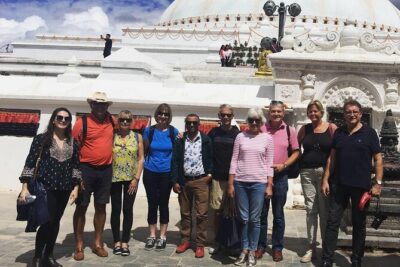
Full Day 7 UNESCO Tour with Lunch – Private/Group
Read our review →
Full Day Top 4 UNESCO Tour with Lunch – Private/Group
Read our review →Full-Day 7 UNESCO Tour with Lunch – Private/Group
Read our review →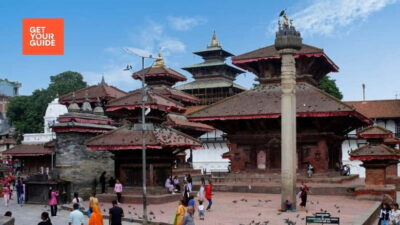
Kathmandu Private Sightseeing Tour | UNESCO World Heritage Sites
Read our review →Browse the lists this tour appears in