
REVIEW · ANNAPURNA BASE CAMP TREKS
12 Days Annapurna Base Camp Trek
The Himalayas reward steady steps. This 12-day Annapurna Base Camp Trek takes you from Kathmandu to 4,130 meters through rhododendron forests, terraced hillsides, and Gurung and Magar villages, with the Annapurna range waiting at the top. I like the contrast between Poon Hill sunrise and the high mountain setting at base camp, and I like that the route ends with a soak in Jhinu Danda’s natural hot springs.
The company’s strongest quality appears to be personal care. Guides are described as friendly, helpful, polite, and attentive, with Mandip Ji receiving special praise for his calm manner and warm smile. The main consideration is the physical demand: the trek is rated moderate, but steep stone steps, repeated climbs, and the altitude at 4,130 meters are not small matters.
In This Review
- Key points to know before you book
- What the $1,200 price really gives you
- Day 1: Kathmandu, permits, and a first briefing
- Day 2: Choosing the road or the quick flight to Pokhara
- Day 3: Nayapul, Birethanti, and Ulleri’s stone staircase
- Day 4: Forest shade on the way to Ghorepani
- Day 5: Poon Hill sunrise and the long route toward Chhomrong
- Day 6: Descending and climbing again to Chhomrong
- Day 7: Bamboo, Dovan, and the gorge near Himalaya
- Day 8: Deurali, MBC, and the arrival at base camp
- Day 9: Sunrise, then the long descent through the valley
- Day 10: Chhomrong and the hot springs at Jhinu Danda
- Day 11: Back to Pokhara for an easier evening
- Day 12: Returning to Kathmandu
- How hard is this Annapurna trek?
- Guides, personal service, and the private format
- What is included, and what should you confirm?
- Who should book this trek?
- Should you book the 12-day Annapurna Base Camp Trek?
- FAQ
- How long is the Annapurna Base Camp Trek?
- How high is Annapurna Base Camp?
- Is pickup offered?
- Can I travel between Kathmandu and Pokhara by road or air?
- Is this a private tour?
- What is the cancellation policy?
Key points to know before you book
- Poon Hill adds a sunrise highlight: An early climb brings views toward Dhaulagiri, Annapurna, and Machapuchare before the main route continues.
- Annapurna Base Camp reaches 4,130 meters: You gain a true high-mountain setting, but altitude and cold conditions require sensible pacing.
- The trail mixes scenery with local life: Rhododendron woods, rice terraces, Magar villages, Gurung communities, and teahouses give the walk a human scale.
- Jhinu Danda provides a natural finish: The riverside hot springs offer a welcome rest after the long descent from the upper valley.
- Kathmandu and Pokhara are part of the plan: You have time in both cities, with a choice of road or air travel between them.
- This is a private trip for your group: That can make the pace and guide attention more personal, but transport and airport taxes need careful checking.
What the $1,200 price really gives you
At $1,200 per person, this is not simply a mountain walk. The price covers a 12-day program beginning in Kathmandu, a guide-led private experience, meals, government fees, entrance fees, WiFi on board, and excess baggage as listed in the package details.
That combination can offer good value if the meals, guide services, permits, and listed transport support match your needs. A private trip is especially useful here because your group does not have to follow the speed of a large mixed party. If one person needs a slower morning or a longer rest, your guide may have more room to respond.
You should clarify exactly what is covered before paying. The package lists public transportation and airport or departure tax as not included. The transfer between Kathmandu and Pokhara may be by a six-to-eight-hour road trip or a 25-minute flight, so ask if either option carries an extra charge.
The price also needs to be judged against the length of the trip. You receive two city transfer days, one arrival day, and several full trekking days. This is a longer, more gradual approach than a rushed base camp program, and the extra time helps the route feel like a journey rather than a quick climb and retreat.
The cancellation terms are friendly if your plans change early. You can receive a full refund by canceling at least 24 hours before the start time. Changes or cancellations inside that window are not refunded, and poor weather may lead to a new date or a full refund.
More Annapurna Base Camp treks:
- Annapurna base camp trek 5 Days
★ 5.0 · 252 reviews - Annapurna Base Camp Trek
★ 5.0 · 111 reviews - Kathmandu to Annapurna Base Camp (ABC) 5-Day Trek
★ 5.0 · 102 reviews
Day 1: Kathmandu, permits, and a first briefing
Your arrival point is Tribhuvan International Airport in Kathmandu. Pickup is offered, and the stated meeting point is in the Thamel area, at P924+79H Kathmandu.
Thamel gives you an easy first base in the capital, with plenty of places to eat, walk, and sort out last-minute needs. The important part of this first day is the trek briefing and permit preparation. You have about 12 hours assigned to the day, though your actual schedule will depend on your flight.
Do not treat this as a throwaway arrival day. Use it to meet your guide, ask about the walking pace, confirm the transport plan, and check what the meal arrangement includes. The guide’s friendly and helpful manner is one of the company’s most praised qualities, so this is the right time to raise practical questions.
Day 2: Choosing the road or the quick flight to Pokhara
You can reach Pokhara by a six-to-eight-hour overland drive or by a flight lasting about 25 minutes. That choice changes the feel of the trip.
The road gives you more time to see Nepal at ground level, but it uses much of a day and may feel tiring before the trek begins. The flight saves time and gets you to the lakeside city quickly, though the schedule and weather may affect it. The package information does not make clear if one option is included in the price, so confirm this directly.
Pokhara sits beside Phewa Lake and offers broad views toward the Annapurna range. It is a calmer place to prepare for the walking days ahead. You can use the evening to rest, organize your pack, and enjoy a meal near the lake rather than rushing straight into the mountains.
Day 3: Nayapul, Birethanti, and Ulleri’s stone staircase
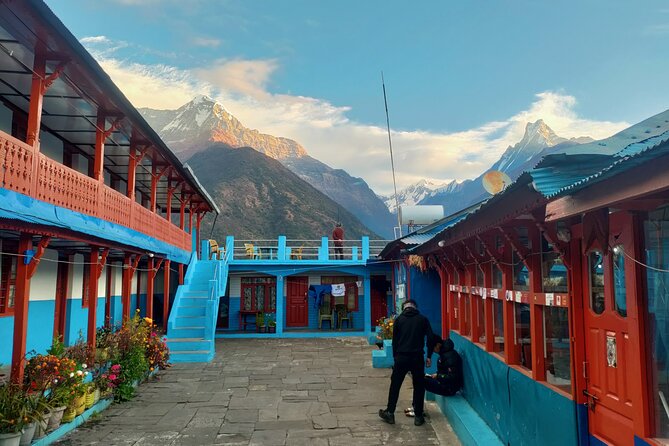
After breakfast, a 1.5-hour drive takes you to Nayapul, the starting point of the walk. The early trail passes through Birethanti and Tikhedhunga on a relatively gentle path before the serious climb begins.
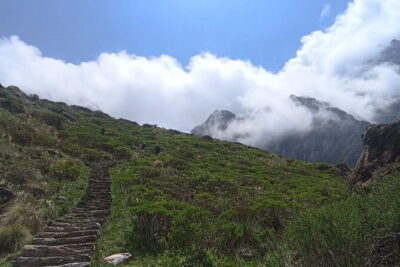
The approach to Ulleri includes more than 3,000 stone steps. That number tells you more than the word moderate ever could. The steps are a sharp test on the first trekking day, especially if you are still adjusting to the pack, heat, and uneven ground.
Ulleri is a village stop with views toward the surrounding mountains. You should keep your pace steady here. Short pauses are more useful than charging ahead and spending the evening exhausted.
More walking in the hills of Kathmandu:
- Everest Base Camp Trek – 14 Days
★ 5.0 · 1,499 reviews - Everest Base Camp Trekking
★ 5.0 · 485 reviews - Nagarkot Sunrise View and Day Hiking from Kathmandu
★ 5.0 · 471 reviews - Annapurna Circuit Trek with Tilicho Lake
★ 5.0 · 368 reviews
Day 4: Forest shade on the way to Ghorepani

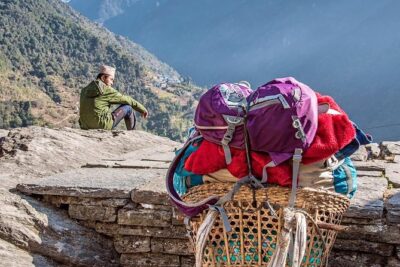
The route continues uphill through rhododendron and oak forests. Waterfalls and Magar villages break up the walking, giving you something to notice besides the next slope.
Ghorepani is a popular overnight stop with an alpine feel and wide mountain views. The cooler air will remind you that you are gaining height. It is also the staging point for the early climb to Poon Hill, so an early night makes sense.
This day may feel easier than the staircase day, but it is still uphill. The forest offers shade, yet the repeated climb can wear on your legs. I would treat the stop in Ghorepani as a real recovery period, not just a place to drop your bag.
Day 5: Poon Hill sunrise and the long route toward Chhomrong
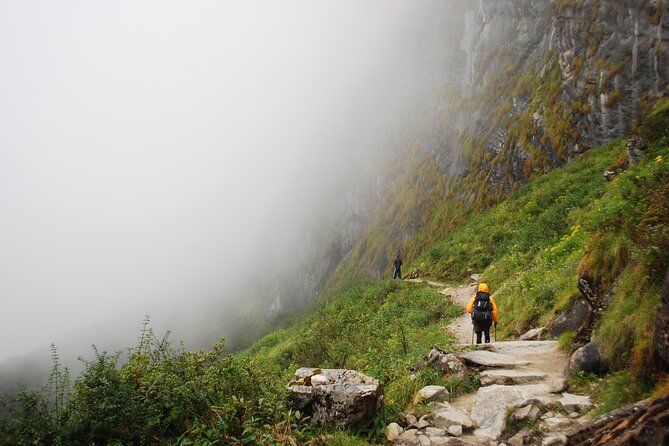
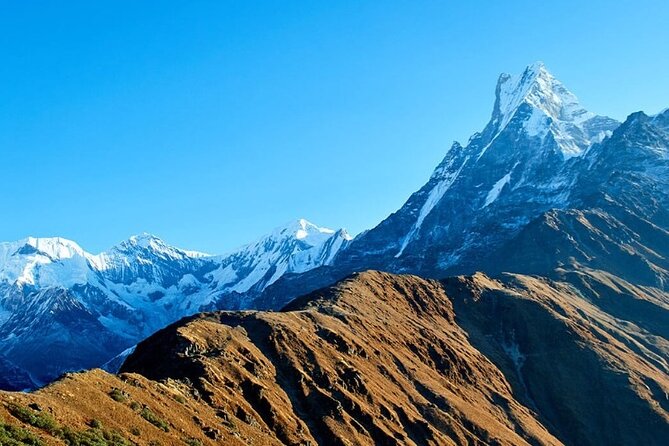
The morning begins before breakfast with a hike to Poon Hill. From the viewpoint, you can watch the sun reach Dhaulagiri, Annapurna, and Machapuchare. This is one of the route’s most memorable moments because the view arrives gradually, with the peaks changing color as the light improves.
After returning to Ghorepani for breakfast, you continue through forest toward Chhomrong. The day combines an early climb, a descent, and more walking, so it can feel long even though the sunrise is a fine reward.
Chhomrong is a large Gurung village with strong views toward Annapurna South and the sacred Machapuchare. The village setting gives the trek a clear sense of place. You are not simply walking through empty mountain scenery. You are moving between communities shaped by the slopes around them.
Day 6: Descending and climbing again to Chhomrong
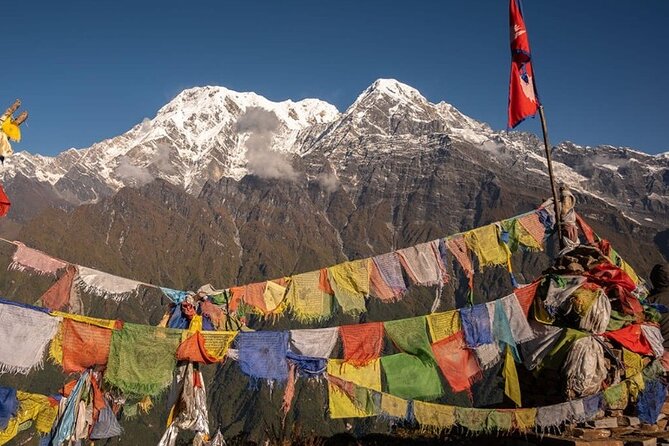
The route descends to a stream, then climbs back through terraced farmland and forest. This up-and-down pattern is typical of Himalayan trails, and it can be more tiring than a steady climb.
Terraces show how local communities have made use of steep ground over many years. The walk through farmland and forest also gives you a better change of rhythm after the open views around Ghorepani and Poon Hill.
Chhomrong’s views are a major reward, but reaching it requires effort. If you prefer a gentle walking holiday, this is a point to consider carefully. The trip is described as suitable for people with moderate fitness, not for someone seeking an easy sightseeing route.
Day 7: Bamboo, Dovan, and the gorge near Himalaya
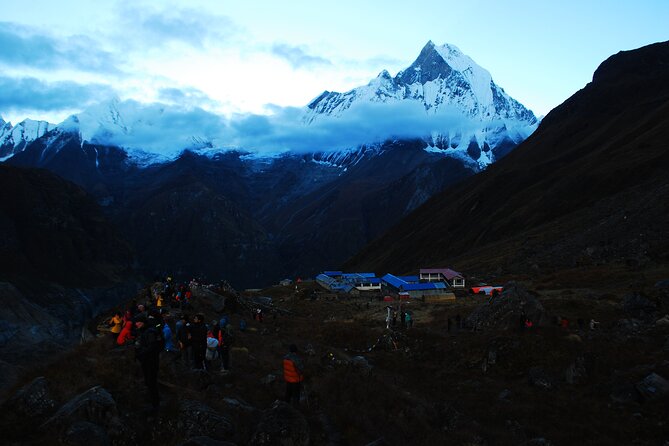
You begin by descending toward the river, then climb to Sinuwa. From there, the trail enters bamboo forest and continues through Bamboo and Dovan before reaching Himalaya.
This section feels quieter and more enclosed than the earlier hills. The thick forest and river corridors make the walk feel sheltered, but the trail still includes climbs and uneven ground. You may find the change in scenery refreshing, especially after the open farmland around Chhomrong.
The day brings you closer to the high valley. That matters because the route is gradually moving from village country into a more alpine setting. Keep your breathing and pace under control rather than trying to prove anything on this stage.
Day 8: Deurali, MBC, and the arrival at base camp
The forest begins to thin as you pass Deurali and continue toward Machapuchare Base Camp, often shortened to MBC. Open alpine meadows replace much of the lower woodland, and the mountain walls feel closer.
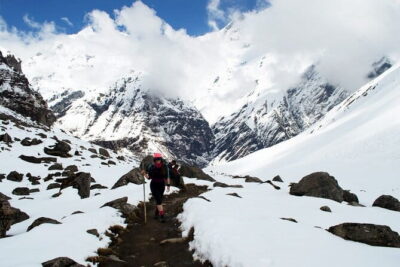
From MBC, the trail climbs gradually to Annapurna Base Camp at 4,130 meters. The route is not described as a technical mountaineering trip. It is a trekking ascent on an established trail, but the altitude makes every climb more demanding.
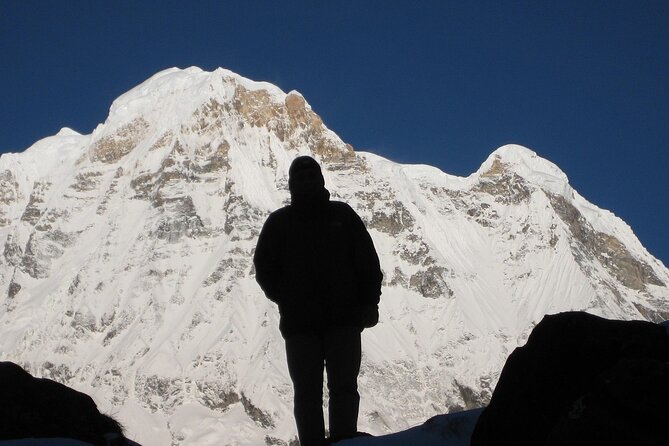
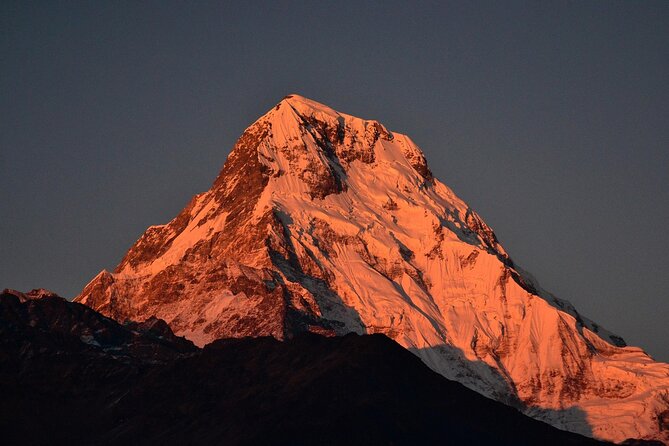
Base camp is the main prize. Towering peaks surround the site, giving you the feeling of being inside a mountain amphitheater. The plan allows time for sunset, which is valuable because the light can give the peaks a completely different character from the morning views.
At this height, comfort may be basic, and cold conditions are possible. The supplied details do not specify room types, heating, or the exact teahouse standard, so ask before departure if those points matter to you. Carry layers you can add easily, and do not rush the final approach.
Day 9: Sunrise, then the long descent through the valley
An early sunrise at base camp gives you one more look at the Annapurna range before the return begins. You then retrace the trail through MBC, Deurali, and Dovan, eventually reaching the forest at Bamboo.
Descending is usually easier on the lungs, but it is not effortless. The route is long, and uneven steps can be hard on knees and ankles. Trekking poles would be a sensible personal addition, though they are not specifically listed as provided.
The return along the same trail has one advantage: you recognize places from the climb and can see them from a new angle. It also means there is less surprise in the day. You know the broad shape of the route, which can help you manage your energy.
Day 10: Chhomrong and the hot springs at Jhinu Danda
The trail climbs back to Chhomrong, then drops steeply to Jhinu Danda. This is another day where the word descent should not fool you. A steep downhill can be demanding after several days on foot.
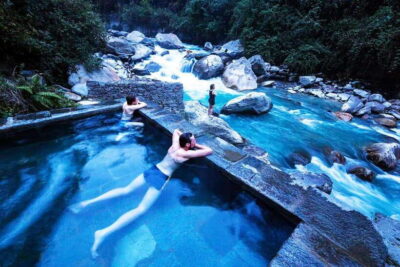
The reward is Jhinu Danda’s natural hot springs beside the river. A warm soak offers a simple, memorable end to the hard mountain section. It is also a welcome change from the repeated rhythm of teahouse, trail, and uphill steps.
I like this design in the schedule. Instead of finishing at base camp and rushing straight back to the city, the route gives you a physical and emotional cooldown. You get one last village setting, then a chance to relax before returning to Pokhara.
Day 11: Back to Pokhara for an easier evening
A short trek takes you to Siwai or Nayapul, followed by a drive back to Pokhara. The details allow either endpoint, so confirm which one applies to your group and how long the vehicle transfer should take.
This is a good night for a lakeside dinner, a massage, or simply a quiet rest. After the altitude, stairs, and long descents, an easy evening in Pokhara can feel like a real part of the reward.
You also have a chance to think about the contrast between the trip’s beginning and end. On Day 2, the Annapurna range is viewed from a peaceful city. By Day 11, you have walked into its high valleys and returned under your own power.
Day 12: Returning to Kathmandu
The final transfer is by flight or road. A flight is listed at about 25 minutes for the Kathmandu and Pokhara connection, while the overland option takes roughly six to eight hours. Your choice will depend on timing, cost, and weather.
If your international flight leaves soon after arrival, check the schedule carefully. The plan says you may go directly to the airport or spend another night in Kathmandu, depending on your flight time.
The trip ends back at the stated Kathmandu meeting point. Airport or departure tax is not included, so keep that separate from your main tour budget.
How hard is this Annapurna trek?
The route is labeled moderate, and that is a fair starting point for someone who already walks regularly. Still, the 3,000-plus steps to Ulleri, the repeated descents and climbs, the long return from base camp, and the 4,130-meter altitude make this a serious physical holiday.
You should be comfortable walking for several hours on uneven trails and climbing steep sections. The exact daily walking hours are not supplied, so ask the operator for a more detailed schedule before booking.
The high point is not just a number. At 4,130 meters, you may feel the altitude more than expected. The practical answer is to walk at the guide’s pace, rest when needed, and speak up early if you feel unwell. The route is established, but no mountain trip removes the need for caution.
Guides, personal service, and the private format
The company receives its strongest praise for guide attitude and personal attention. The most useful names attached to that praise are Mandip Ji, described as calm, caring, polite, and good-humored, along with a guide described as friendly and ready to help when needed.
Those qualities matter on a trek. A cheerful guide can make a difficult day feel manageable, while a guide who pays attention can help you handle small problems before they become large ones. You should still ask who will lead your group, what experience they have on the Annapurna route, and how emergency support is handled.
Because this is a private activity, only your group participates. That suits couples, families, and friends who want a more personal pace. It may cost more than joining a large group, but the $1,200 price already includes several services and the benefit of traveling with your own party.
What is included, and what should you confirm?
The package lists meals, government fees, admission and entrance fees, WiFi on board, and excess baggage. It also includes pickup as an available feature.
The wording around transport deserves attention. Public transportation and airport or departure tax are listed as exclusions, while the route uses drives and may use flights. Before booking, ask these direct questions:
- Is the Kathmandu to Pokhara and Pokhara to Kathmandu transport included?
- If flights are used, are their fares included?
- Which meals are covered on trekking days?
- What does excess baggage cover?
- Are trekking permits included under government fees?
- Is airport pickup included for every arrival time?
These are not reasons to reject the trip. They are the details that help you compare the $1,200 cost fairly with other Annapurna programs.
Who should book this trek?
I would recommend it to someone who wants a classic Himalayan route with a clear high point, village contact, forest walking, and a little time in Kathmandu and Pokhara. It is also a good fit if you value a private group and want a guide who is expected to be attentive rather than distant.
The route works well for people with moderate physical fitness who are ready for steep steps and long days. It is not the right pick if you want short walks, guaranteed road access, or a soft hotel-style holiday throughout.
The trip is also a sensible choice if Poon Hill matters to you. That sunrise viewpoint adds a second mountain highlight before base camp, rather than saving every scenic moment for the final destination.
Should you book the 12-day Annapurna Base Camp Trek?
I would book this trek if you want a well-known Nepal route with strong scenery and a useful mix of culture, forest, mountain views, and recovery time. The combination of Poon Hill, Annapurna Base Camp, Gurung and Magar villages, teahouse hospitality, and Jhinu Danda’s hot springs gives the trip good variety.
I would pause if you dislike steep stairs, long descents, uncertain transport costs, or high-altitude walking. Before committing, confirm the flights or road transfers, meal details, guide assignment, and what the $1,200 price excludes.
For a private 12-day program, the value looks solid if those transport details are settled in your favor. The company’s most convincing strength is its reported care at guide level, especially the praise connected with Mandip Ji. That personal service can make a demanding route feel far more approachable.
FAQ
How long is the Annapurna Base Camp Trek?
The experience lasts approximately 12 days, beginning and ending in Kathmandu.
How high is Annapurna Base Camp?
Annapurna Base Camp is at an altitude of 4,130 meters.
Is pickup offered?
Yes. Pickup is offered, and the stated meeting point is in the Thamel area of Kathmandu.
Can I travel between Kathmandu and Pokhara by road or air?
Yes. The plan offers a six-to-eight-hour overland drive or a flight of about 25 minutes in each direction. Confirm which option is included before booking.
Is this a private tour?
Yes. Only your group will participate.
What is the cancellation policy?
You can cancel at least 24 hours before the start time for a full refund. Cancellations or changes made less than 24 hours before the start time are not refunded. If poor weather cancels the experience, you will be offered a different date or a full refund.
New in the Kathmandu listings
- Traditional Momo Making Class★ 5.0 · 10 reviews
- Kathmandu: Ancient City Kirtipur & Pharping Monastery Tour★ 5.0 · 2 reviews
- Kathmandu to Pokhara Premium sofa bus ticket★ 4.0 · 17 reviews
- Women Empowerment Project(Nepali cooking class & jewelry workshop★ 5.0 · 15 reviews
- Yoga Experience Day Trip with Private Transfer From Kathmandu★ 4.0 · 2 reviews
- 7-Day Langtang Valley Trek from Kathmandu★ 5.0 · 1 review
- Kathmandu 2 Nights 3 Days Chitwan Jungle Safari Tour★ 5.0 · 9 reviews
- Wildlife Adventure in Chitwan Nepal★ 4.0 · 4 reviews
Annapurna Base Camp Treks, compared.
Kathmandu to Annapurna Base Camp (ABC) 5-Day Trek
Read our review →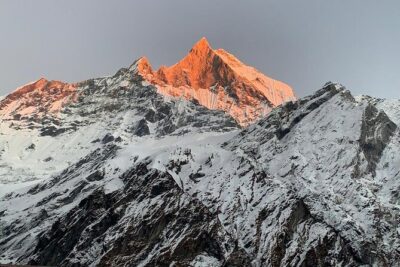
Kathmandu/Pokhara: 5-Day Annapurna Base Camp (ABC) Trek
Read our review →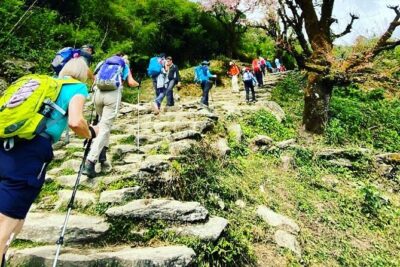
11-Day Hike Tour to Annapurna Base Camp Bliss in Kathmandu
Read our review →Browse the lists this tour appears in