
REVIEW · ANNAPURNA BASE CAMP TREKS
Annapurna Base Camp Trek 13 Days
The mountains arrive early. This 13-day Annapurna Base Camp Trek combines Himalayan views, Gurung villages, forest trails, and a sunrise at Poon Hill before reaching the foot of Annapurna. I like the route’s variety, and I like that permits, transfers, guides, porters, and most meals are already arranged. The main consideration is the physical demand: you need moderate fitness, and altitude, steep stone steps, and long walking days are part of the bargain.
You also get a useful mix of comfort and local travel. Kathmandu and Pokhara hotels provide a soft landing, while twin-share guesthouses carry you into the Annapurna Sanctuary. The bus from Kathmandu to Pokhara can be a long day, and the $200 single supplement may apply if you book alone and cannot share a room.
In This Review
- Key points before you book
- Why this Annapurna route works so well
- Arrival in Kathmandu and the first briefing
- Kathmandu to Pokhara, a long but useful transfer
- Nayapul to Tikhedhunga: a gentle trail opening
- Ulleri and Ghorepani, the first serious climb
- Poon Hill sunrise and the walk to Tadapani
- Tadapani to Chhomrong through Gurung country
- Chhomrong to Bamboo and the river corridor
- Into Annapurna Sanctuary and Annapurna Base Camp
- The return to Bamboo and Jhinu Danda
- Birethanti, Phewa Lake, and the return to Pokhara
- Kathmandu farewell and airport transfer
- What the $1,299 price really covers
- Who should book this trek
- Practical details that matter
- FAQ
- How long is the Annapurna Base Camp Trek?
- What is the tour price?
- Is airport pickup included?
- What accommodation is included?
- Are meals included?
- Is a guide included?
- Do I need travel insurance?
- How difficult is the trek?
- Should you book the Annapurna Base Camp Trek?
Key points before you book
- Poon Hill sunrise comes before base camp: The early climb gives you a famous mountain viewpoint before the trail turns toward Annapurna Sanctuary.
- Annapurna Base Camp is the high point: You walk through Machapuchhare Base Camp and into a mountain-ringed basin beneath Annapurna.
- The route mixes culture and nature: Gurung villages, rhododendron and oak forests, rivers, hot springs, and high mountain views all appear along the way.
- A small group keeps things manageable: The maximum group size is 14, with one porter assigned for every two hikers.
- Most major costs are covered: Permits, lodging, three main meals on most trekking days, ground transfers, guide service, and porters are included.
- Bring proper insurance: Emergency high-altitude rescue and evacuation must be covered by your own travel insurance.
Why this Annapurna route works so well
At $1,299 per person, this is not just a guided walk to one viewpoint. It is a full Nepal trip with airport pickup, two nights in Kathmandu, one night in Pokhara, eight nights in trekking guesthouses, ground transportation, meals, permits, a guide, and porter support.
I see the route as a good choice for someone who wants a proper Himalayan trek without arranging each moving part alone. You still get real village life and simple mountain lodging, but you do not need to negotiate every bus, permit, room, or trail decision yourself.
The route is also well chosen. Poon Hill adds a dramatic sunrise viewpoint, while Annapurna Base Camp provides the main goal. The trail does not simply climb and stop. You pass through lower hill villages, forests, river valleys, and the high sanctuary, then return through Jhinu Danda and Pokhara.
The tradeoff is time spent on transport. Kathmandu to Pokhara is by tourist bus, with pickup around 6:30 in the morning on Day 2. This is practical and less expensive than flying, but it may feel tiring after arriving in Nepal. The trip also includes a return bus to Kathmandu on Day 12.
More Annapurna Base Camp treks:
- Annapurna base camp trek 5 Days
★ 5.0 · 252 reviews - Annapurna Base Camp Trek
★ 5.0 · 111 reviews - Kathmandu to Annapurna Base Camp (ABC) 5-Day Trek
★ 5.0 · 102 reviews
Arrival in Kathmandu and the first briefing
Your airport pickup begins the service. Look for a representative holding a Places Nepal Trek & Tours sign, then transfer to your Kathmandu hotel.
A pre-trip meeting takes place at the company office on your first or second day. This is when you meet your guide, review the plan, complete required paperwork, and settle any remaining balance. Bring your passport, three passport-size photos, and a copy of your travel insurance.
That meeting matters. You should use it to ask about the day-by-day pace, the porter arrangement, guesthouse expectations, and what gear you need to carry yourself. A licensed English-speaking guide is included. Other languages can be arranged for an additional charge.
One personal detail adds some warmth to the service. A guide named Nam received especially strong praise for being prepared, patient, attentive, and a good photographer. Nam was also described as speaking English and Spanish well. Guides can change, so do not assume Nam will lead your departure, but the comment gives you a useful picture of the level of care the company aims to provide.
Kathmandu to Pokhara, a long but useful transfer
Day 2 begins early with a transfer to the tourist bus station. The bus takes you to Pokhara, a calmer city beside Phewa Lake and a common starting point for Himalayan walks.
This is a full travel day rather than a sightseeing day. You should keep your daypack organized, carry water and snacks, and avoid placing essentials in luggage that you cannot reach easily. The tour includes one night in a three-star Pokhara hotel, giving you a chance to sleep properly before the trail begins.
Pokhara also gives the route a pleasant change of pace. Kathmandu is the arrival point and administrative center, while Pokhara feels more directly connected to the mountains. On the return, you have time for Phewa Lake and a boat ride to Barahi Temple.
Nayapul to Tikhedhunga: a gentle trail opening
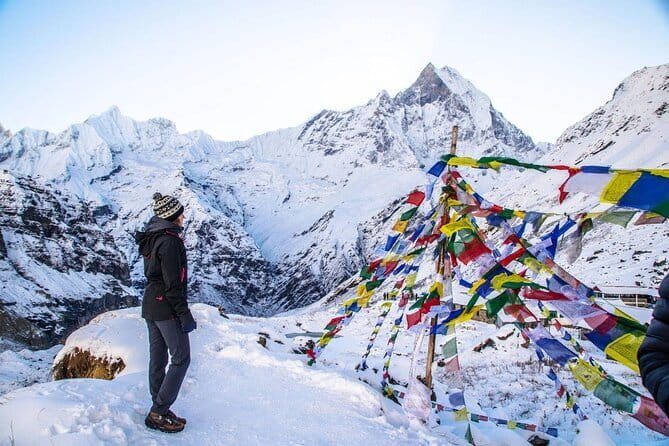
After a short drive from Pokhara, the trek begins at Nayapul. You follow the river toward Birethanti, then climb along the valley toward Tikhedhunga.
This is described as an easier warm-up day, which is welcome. Your body is still adjusting to walking with a pack, and the trail gives you a first look at village life and river scenery without immediately demanding the hardest climb.
The guesthouse accommodation begins here. Rooms are twin-share, and the mountain lodging is simpler than your Kathmandu and Pokhara hotels. That is part of the experience, but you should be ready for basic facilities and shared arrangements rather than hotel-style comfort.
More walking in the hills of Kathmandu:
- Everest Base Camp Trek – 14 Days
★ 5.0 · 1,499 reviews - Everest Base Camp Trekking
★ 5.0 · 485 reviews - Nagarkot Sunrise View and Day Hiking from Kathmandu
★ 5.0 · 471 reviews - Annapurna Circuit Trek with Tilicho Lake
★ 5.0 · 368 reviews
Ulleri and Ghorepani, the first serious climb
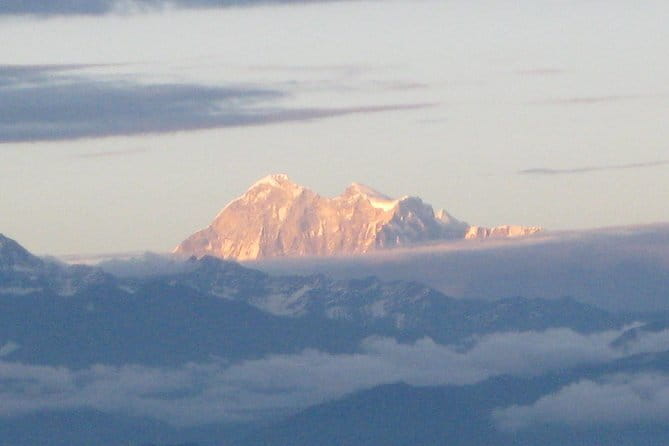
Day 4 brings a stronger test as you climb toward Ulleri, a large village on the route to Ghorepani. After Ulleri, the trail passes through oak and rhododendron forest.
This is where the trek begins to feel like a real mountain journey. The climb can be demanding, especially if you are not used to sustained uphill walking. Take a steady pace rather than trying to keep up with the fastest person in the group.
Ghorepani is important because it sets up the next morning’s Poon Hill sunrise. Your guide will help manage the timing, but you should keep warm clothing and a headlamp easy to reach. You will be leaving before breakfast.
Poon Hill sunrise and the walk to Tadapani
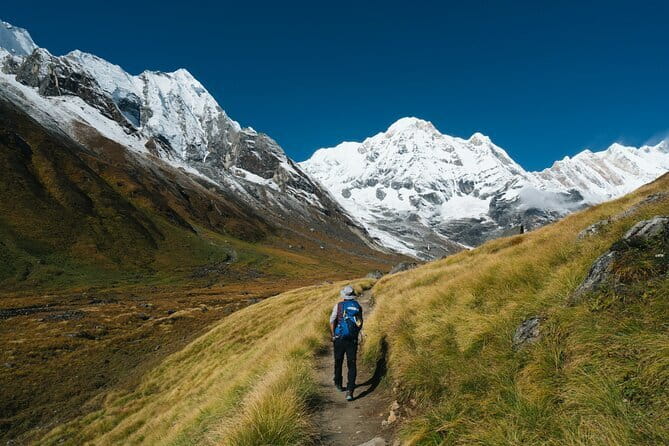
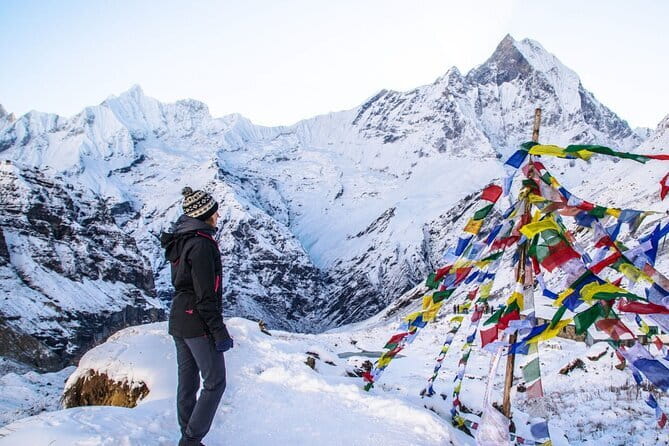
The early climb to Poon Hill is one of the route’s best features. You reach the viewpoint before sunrise, then watch light spread across the Himalayan peaks.
The information provided does not name every peak visible from Poon Hill, so the exact view depends on conditions. Still, the viewpoint is included for a reason: it gives you a broad mountain panorama before the trail turns deeper into the Annapurna region.
After returning to Ghorepani for a hot breakfast, you walk through forest toward Tadapani. This day combines an early uphill push, a meal break, and more trail walking, so it may feel longer than the short Poon Hill viewpoint stop suggests.
Poon Hill is also a good example of how this trek balances famous sights with ordinary trail life. The sunrise is the headline moment, but the forest route and overnight stop are what make the journey feel complete.
Tadapani to Chhomrong through Gurung country
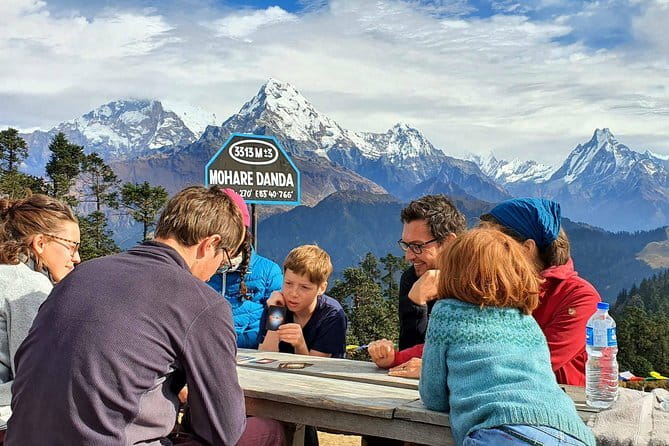
From Tadapani, the path drops through rhododendron forest and reaches Gurjung, a village associated with the Gurung people. From there, the route continues toward Chhomrong.
The village stops are valuable because they place the mountains in a human setting. You are not simply walking through empty high country. You see the pattern of hill villages, farms, trails, and guesthouses that support life along the route.
Chhomrong is an important point on the approach to Annapurna Base Camp. The route begins to feel more focused, but you still have substantial walking ahead. Pace yourself here. A day that feels easy on the way up can become tiring when repeated climbs and descents accumulate.
Chhomrong to Bamboo and the river corridor
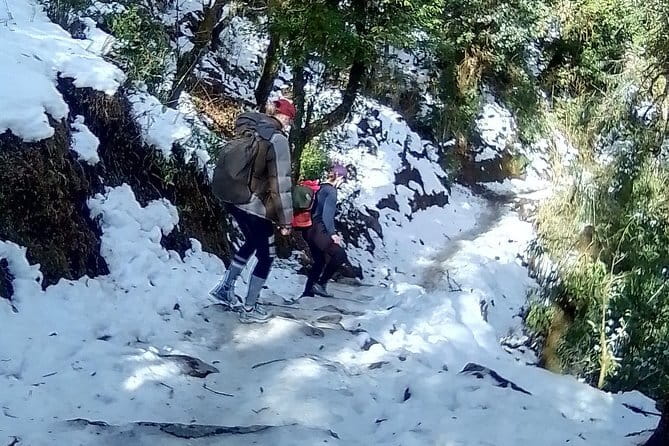
Day 7 takes you downhill to a river, then back uphill toward Khuldighar. From there, the route passes through forest, drops along a steep rock bank, and continues beside the river toward Himalayan Hotel before reaching Bamboo.
This is a classic Himalayan trail pattern: down first, then up again. Do not judge difficulty only by altitude gain. Descents can be hard on knees, while the next climb can feel worse after your legs have already worked.
Bamboo provides trekking accommodation and marks a more enclosed part of the route. Forest and river sounds replace the broad village views of the lower trail. The official schedule includes some stop durations that read like data-entry errors, including several listed as 18 or 19 hours. You should treat the sequence of overnight stops as the useful information, not those displayed hour figures.
Into Annapurna Sanctuary and Annapurna Base Camp
From Bamboo, the trail continues past a cave and Deurali before reaching Machapuchhare Base Camp. Despite its name, this is not a climbing base camp for Machapuchhare, since that mountain cannot be climbed. It is a stopping point on the approach to the sanctuary.
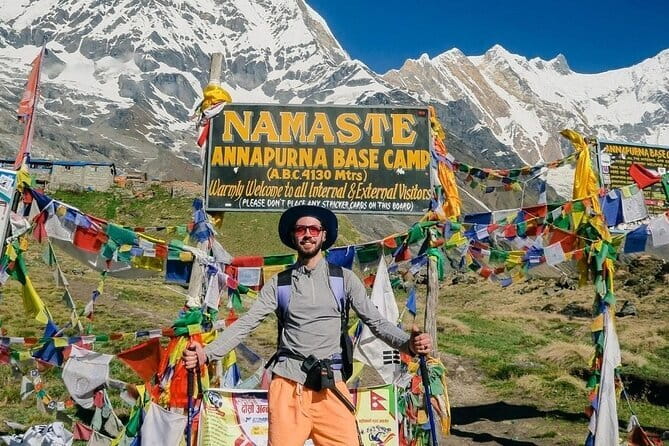
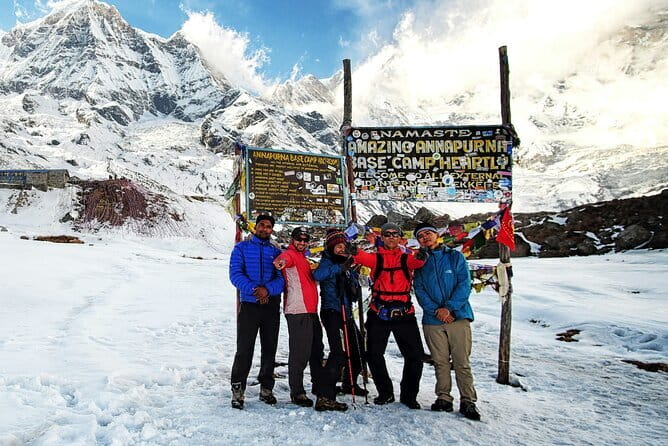
From Machapuchhare Base Camp, the walk continues for about two hours to Annapurna Base Camp. Here, the mountains surround you on all sides, including Annapurna I, Annapurna South, Machapuchhare, and Hiunchuli.
This is the defining part of the trek. The sanctuary setting gives you a sense of arrival that a simple viewpoint cannot match. You have walked through villages and forests, followed rivers, climbed stone trails, and finally reached a high basin beneath major Himalayan peaks.
At this altitude, conditions can change, and the trip requires proper preparation. The tour specifically requires you to arrange your own insurance covering high-altitude emergency rescue and evacuation. That is not a box to tick casually. Check the wording before departure and carry proof of coverage.
The return to Bamboo and Jhinu Danda
The route returns the way it came, descending toward Bamboo. The return may feel familiar, but it is not effortless. Downhill walking can be hard after the summit portion, and the same forests, river crossings, and stone paths still require attention.
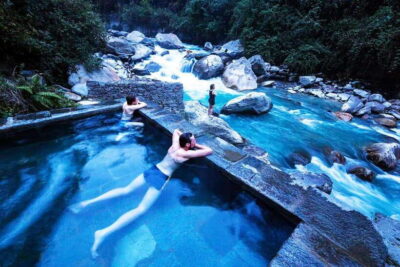
On Day 10, you pass back through Chhomrong and continue toward Jhinu Danda. The route includes forest walking, an experimental sheep farm, and a descent to the hot springs.
Jhinu is a well-timed stop. After several days on foot, a hot spring offers a simple way to relax before the final return to lower ground. It also gives the trek a different kind of reward. Not every memorable stop needs to be a mountain viewpoint.
Birethanti, Phewa Lake, and the return to Pokhara
The final trekking section follows the river to Birethanti. This is described as a particularly pleasant and easygoing part of the route, a fitting change after the high sanctuary and repeated descents.
A short drive returns you to Pokhara. After checking into your hotel, you visit Phewa Lake and take a boat to Barahi Temple. This lake outing helps separate the trek from the journey home, and it gives you a relaxed evening in one of Nepal’s best-known visitor bases.
The Pokhara night is included, but lunch and dinner in Pokhara are not. That is reasonable because the city has many dining choices, but you should budget for those meals and for drinks throughout the trip. Alcoholic beverages and hot and cold drinks are not included.
Kathmandu farewell and airport transfer
Day 12 brings the bus ride back to Kathmandu. The schedule allows time for extra activities if you extend your stay, including a jungle safari, rafting, city exploration, or mountain biking, but those activities are not part of the trek price.
The included farewell dinner takes place at a Nepalese restaurant with cultural shows. Dinner is included on this evening, along with the other specified meals across the trip.
On the final day, a representative transfers you to Tribhuvan International Airport. The tour ends back at the Kathmandu meeting point, so confirm your departure details with the local office during the trip.
What the $1,299 price really covers
The strongest value comes from the services that are easy to underestimate. Your price includes:
- Airport transfers
- Three hotel nights in Kathmandu and Pokhara
- Eight nights in twin-share trekking guesthouses
- A licensed English-speaking guide
- One porter for every two hikers
- Trekking permits
- Kathmandu to Pokhara tourist bus transportation
- Pokhara to Nayapul transport and the return ground transfers
- A Places Nepal duffel or kit bag and sun hat
- Government taxes and service charges
- Breakfast for 12 days
- Lunch for nine days
- Dinner for nine days
- Poon Hill and Pokhara admission fees
The price applies per person for one or two people, but it assumes twin sharing. If you travel alone and no roommate is available, a $200 single supplement is charged on arrival in Nepal. The same supplement applies if you want a private room throughout the trek.
You still need to pay for international flights, the Nepal entry visa, personal trekking gear, city meals in Kathmandu and Pokhara, drinks, insurance, and tips. Tipping is expected for the trekking staff and driver, so include it in your budget rather than treating it as an optional surprise.
Who should book this trek
I would recommend this trip to someone with moderate physical fitness who wants a structured Himalayan trek and does not want to manage permits, transfers, porters, and guesthouses alone.
It suits you especially well if you want several kinds of scenery in one trip: forest, river valley, Gurung villages, hot springs, a sunrise viewpoint, and high mountain surroundings. The group limit of 14 is also reasonable. It is small enough for a guide to keep track of the group without promising a private trekking experience.
I would think twice if you dislike early starts, long ground transfers, twin-share rooms, or repeated uphill and downhill walking. You should also be comfortable with simple guesthouse accommodation and the possibility that mountain conditions can affect the experience.
Practical details that matter
Pickup is offered, and a mobile ticket is available. The stated starting point is P885+RG9, Paknajol Marg, Kathmandu 44600, Nepal.
Confirmation is provided at booking. The activity is near public transportation, but the organized transfers mean you are not expected to arrange the main route yourself.
The cancellation rule is fairly clear: cancel at least three full days before the local start time for a full refund. Cancellations or changes inside that window are not accepted for a refund.
The trip received a top rating from the single published account, with especially strong praise for organization and the personal service of guide Nam. That is a small sample, so I would not treat it as proof that every departure will be identical. Still, it supports the practical impression of a company that pays attention to preparation, communication, and staff care.
FAQ
How long is the Annapurna Base Camp Trek?
The trek lasts approximately 13 days, including arrival and departure transfers, hotel stays in Kathmandu and Pokhara, the walking route, and the return to Kathmandu.
What is the tour price?
The listed price is $1,299 per person. A $200 single supplement may apply if you travel alone and cannot be matched with someone for twin sharing, or if you request a private room throughout the trek.
Is airport pickup included?
Yes. A representative meets you at the airport holding a Places Nepal Trek & Tours sign and transfers you to your hotel.
What accommodation is included?
The package includes twin-sharing rooms in three-star hotels for two nights in Kathmandu and one night in Pokhara. During the trek, you receive eight nights in twin-share guesthouse rooms.
Are meals included?
Breakfast is included for 12 days, lunch for nine days, and dinner for nine days. Lunch and dinner in Kathmandu and Pokhara are not included, and alcoholic as well as hot and cold drinks are extra.
Is a guide included?
Yes. A licensed English-speaking trek guide is included. A guide speaking another language can be requested for an additional charge.
Do I need travel insurance?
Yes. You must arrange individual travel insurance that covers emergency high-altitude rescue and evacuation. International airfare and the Nepal entry visa are also your responsibility.
How difficult is the trek?
The activity requires a moderate level of physical fitness. The route includes uphill and downhill walking, forest trails, river sections, the climb to Poon Hill, and the approach to Annapurna Base Camp.
Should you book the Annapurna Base Camp Trek?
I would book this trek if you want a well-organized first Himalayan experience with real walking, strong mountain scenery, and a sensible range of included services. The combination of Poon Hill, Annapurna Base Camp, Gurung villages, forest, hot springs, and Phewa Lake gives you more variety than a route focused on one destination.
Before paying, confirm the single-room policy, ask what personal gear you need, and check that your insurance covers high-altitude evacuation. If you can handle basic guesthouses, an early sunrise walk, a long bus ride, and moderate physical effort, the $1,299 package offers a practical way to reach Annapurna Base Camp without giving up the local trail experience.
New in the Kathmandu listings
- Kathmandu: Ancient City Kirtipur & Pharping Monastery Tour★ 5.0 · 2 reviews
- Traditional Momo Making Class★ 5.0 · 10 reviews
- Kathmandu to Pokhara Premium sofa bus ticket★ 4.0 · 17 reviews
- Women Empowerment Project(Nepali cooking class & jewelry workshop★ 5.0 · 15 reviews
- 7-Day Langtang Valley Trek from Kathmandu★ 5.0 · 1 review
- Kathmandu 2 Nights 3 Days Chitwan Jungle Safari Tour★ 5.0 · 9 reviews
- Yoga Experience Day Trip with Private Transfer From Kathmandu★ 4.0 · 2 reviews
- Wildlife Adventure in Chitwan Nepal★ 4.0 · 4 reviews
Annapurna Base Camp Treks, compared.
Kathmandu to Annapurna Base Camp (ABC) 5-Day Trek
Read our review →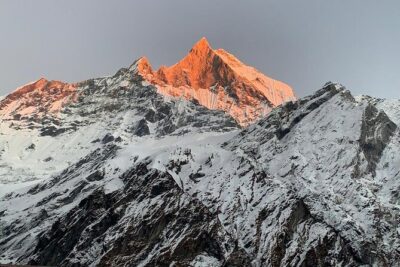
Kathmandu/Pokhara: 5-Day Annapurna Base Camp (ABC) Trek
Read our review →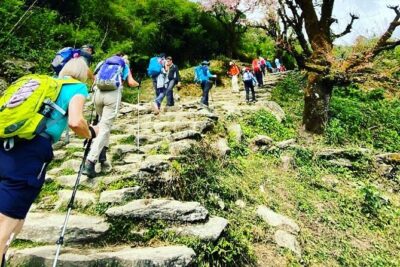
11-Day Hike Tour to Annapurna Base Camp Bliss in Kathmandu
Read our review →Browse the lists this tour appears in