REVIEW · FULL-DAY
Kathmandu Full Day Tour
Four sacred sites, one busy Kathmandu day. This six-hour tour gives you a useful first look at the city’s major Hindu and Buddhist monuments, with hotel pickup and return included. I especially like the four-stop route and the chance to compare Nepali and Tibetan Buddhist traditions with Hindu worship. I also like that guides such as Birodh Burlakoti and Deep helped turn temple visits into understandable stories, not just photo stops.
The main drawback is the pace. Each site receives about an hour, and traffic can eat into that time. You also pay roughly NPR 2,600 per person for entrance fees, on top of the $70 tour price, and one past outing suffered a vehicle breakdown that forced the group to walk beside dusty, busy streets.
In This Review
- Five things to know before you book
- Why this six-hour Kathmandu tour works for first-time visitors
- Kathmandu Durbar Square and the old royal center
- Swayambhunath, the hilltop Buddhist shrine
- Pashupatinath Temple and Hindu religious life
- Boudhanath Stupa, the day’s grand finale
- Guides named Birodh and Deep set the tone
- Transport, group size, and the cost in practice
- Who should book this route
- Final verdict: a useful first day, with extra costs
- FAQ
- How long does the Kathmandu Full Day Tour last?
- What sites are included?
- Is hotel pickup included?
- Is transportation included?
- Are entrance fees included in the $70 price?
- Is lunch included?
- What days does the tour operate?
- How many people can join the tour?
- Can children join?
- Can I cancel for a full refund?
Five things to know before you book
- Four major religious sites in one route: You visit Swayambhunath, Kathmandu Durbar Square, Boudhanath, and Pashupatinath.
- Hotel transfers save time: Pickup and drop-off are included, which is useful when Kathmandu traffic makes meeting points tricky.
- The guide makes the difference: Strong English and clear explanations received the highest praise, especially from guides named Birodh and Deep.
- The entry fees are extra: Budget about NPR 2,600 per person for the UNESCO and temple admissions.
- It is an orientation tour, not a slow study visit: Six hours is enough to see the major sights, but not enough for long wandering at each one.
Why this six-hour Kathmandu tour works for first-time visitors
Kathmandu can feel like a lot on your first morning. Roads are crowded, names are unfamiliar, and the city’s religious sites do not come with a simple one-line explanation. This tour gives you a framework: a former royal center, a hilltop Buddhist shrine, a major Hindu temple, and one of the world’s largest Buddhist stupas.
I like that the route covers two different religious traditions without treating them as interchangeable. At Pashupatinath, you are visiting an important Hindu temple dedicated to Shiva. At Swayambhunath and Boudhanath, you get two very different Buddhist settings, one on a hill and one in a large urban courtyard.
The route also makes sense for a short stay. If you have only a day or two in Kathmandu, arranging four separate visits can be a nuisance. Hotel pickup means you do not need to find an unfamiliar office or roadside meeting point. Private transportation is included, although the size of the group can reach 30 people.
The advertised operating hours are 9:15 AM to 5:15 PM, Monday through Sunday, while the actual sightseeing time is about six hours. The gap allows room for pickup, traffic, and the return journey. Do not expect six perfectly uninterrupted hours inside the monuments.
A short list of alternatives around Kathmandu
- Everest Base Camp Trek – 14 Days
★ 5.0 · 1,499 reviews - Private Kathmandu Sightseeing Tour | UNESCO World Heritage sites
★ 5.0 · 756 reviews - Everest Base Camp Helicopter Tour landing at Everest View Hotel
★ 5.0 · 668 reviews
Kathmandu Durbar Square and the old royal center
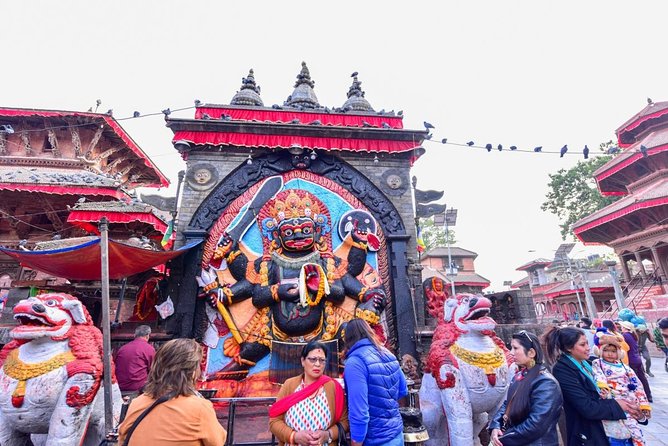
Kathmandu Durbar Square sits in the heart of old Kathmandu at Basantapur. This is the city’s former royal center, a crowded collection of palaces, courtyards, shrines, and temples built during the Malla period.
This first stop gives you the best introduction to Kathmandu’s old civic and religious life. The square is not one single building. It is a connected group of courtyards and monuments, so a guide is useful for explaining what you are looking at and why the royal palace mattered.
The site suffered serious damage in the earthquakes of April and May 2015. Some buildings have been repaired, while others may still show damage or reconstruction work. That is not a reason to skip it. It is part of what you will see in Kathmandu, and it adds a modern layer to the older story of the city.
Plan on about an hour here. That is enough to see the main area and hear the basic background, but you will not have time to inspect every carved window or temple roof. If old architecture is your main interest, you may wish the schedule allowed more time.
Entrance is not included. The total admission cost for the day is listed at about NPR 2,600 per person, so have extra Nepalese rupees available.
Swayambhunath, the hilltop Buddhist shrine
Swayambhunath is often associated with its hilltop position and wide views over Kathmandu. The itinerary gives this site about an hour, which makes it a compact but worthwhile stop early in the day.
The name can be a little confusing because the schedule places Swayambhunath before Kathmandu Durbar Square, while the description attached to that first stop refers to the old royal square. Confirm the order with your guide at pickup. The four intended sights are clear, but the written stop details are not perfectly organized.
Swayambhunath introduces you to Nepali Buddhism in a setting very different from Boudhanath. The religious focus is clear, but the hill setting also gives the stop a sense of separation from the busy streets below. Your guide can help explain the symbols, rituals, and relationship between Nepali and Tibetan Buddhist practice.
You should expect steps and some walking at this stop. The tour says most people can participate, but it does not promise a flat route or special accessibility arrangements. If stairs are difficult for you, ask the operator before booking.
One practical point: do not treat this as only a lookout. The religious meaning matters more than the view. A good guide will explain the stupa and the surrounding shrines instead of rushing you through for photographs.
Pashupatinath Temple and Hindu religious life
Pashupatinath is dedicated to Lord Shiva and is one of the most important Shiva pilgrimage sites in Asia. The temple complex dates back to the fifth century, with later work carried out by Malla rulers.
This is the Hindu half of the tour’s religious contrast. The visit helps you see how different the atmosphere and traditions can be from the Buddhist monuments. Your guide can explain the site’s importance, but remember that Pashupatinath remains an active religious place, not a museum arranged for sightseeing.
The scheduled visit lasts about an hour. That gives you time to understand the complex and its role, though not to explore every corner. Be attentive to local customs and follow your guide’s instructions about where visitors may go.
As with the other major sites, admission is extra. The tour price covers transportation and guiding, not the entrance tickets. That distinction matters when you compare the $70 cost with other half-day sightseeing options.
Pashupatinath is also one of the stops where a calm, respectful guide adds real value. The subject matter can be unfamiliar, and a rushed explanation may leave you seeing only buildings. The strongest guide feedback centered on clear English and explanations that brought the sites to life.
A completely different way to spend the day:
- Half day cooking class in Thamel kathmandu
★ 5.0 · 607 reviews - Everest Base Camp Trekking
★ 5.0 · 485 reviews - Nagarkot Sunrise View and Day Hiking from Kathmandu
★ 5.0 · 471 reviews - Kathmandu: Full Day 7 UNESCO Tour with Lunch – Private/Group
★ 5.0 · 415 reviews
Boudhanath Stupa, the day’s grand finale
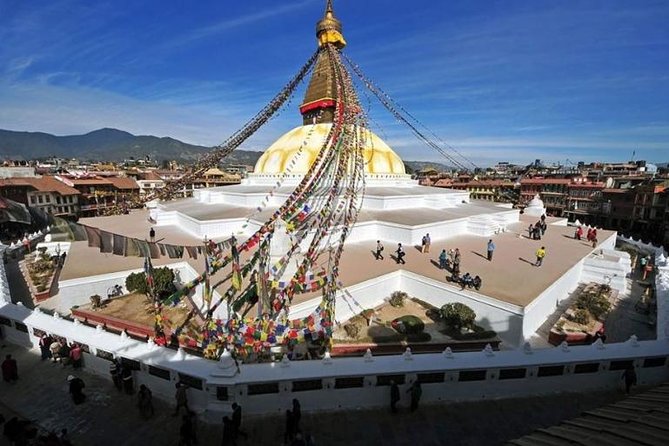
Boudhanath is about eight kilometers east of central Kathmandu and is described as a 36-meter-high stupa. It is the largest stupa in the Kathmandu Valley and one of the city’s most recognizable landmarks.
This is often the most visually direct stop. The great white dome and painted eyes create a simple, memorable image, but the place is more than a monument to photograph. It is a major center of Tibetan Buddhist practice, and the surrounding area adds context to the stupa itself.
You have about an hour here. That is enough to walk around the main structure, listen to an explanation, and take in the setting. One especially useful detail from the tour experience is that lunch can be taken above the stupa, although lunch itself is not included. If you choose to eat there, check the time with your guide so the meal does not make the group late.
Boudhanath is a good final stop because it leaves you with a strong sense of place. It also gives you a second Buddhist site to compare with Swayambhunath. One is associated with a hilltop setting, the other with a large urban stupa and Tibetan Buddhist culture.
Guides named Birodh and Deep set the tone
The most praised part of this experience is the guiding. A guide with strong English can make a major difference in Kathmandu, where the sites have layered names, unfamiliar symbols, and long religious traditions.
Birodh Burlakoti received especially warm praise for being courteous, funny, helpful, and good at photography. He also helped a first-time visitor feel comfortable in a new city and find their bearings quickly. That is a useful service on day one, when Kathmandu can feel confusing.
Deep was praised for clear English and a strong understanding of the places visited. His explanations helped prevent the common problem of seeing several temples and feeling that they all look alike. That is exactly where a guide earns the fee.
Guide quality may vary from departure to departure. One person found the guide’s pace too quick to keep up with, while another noted that unclear English pronunciation could make names and explanations hard to follow. When you meet your guide, tell them if you want more time for photographs, slower walking, or extra explanation.
The tour also received praise for guides sharing additional details in Thamel when time allowed. That suggests the experience can be more flexible when the group is small, or when you are the only person booked. Do not count on a private Thamel walk, but it may happen if the schedule and group permit.
Transport, group size, and the cost in practice
At $70 per person, this is not simply a ticket to four monuments. The price includes hotel pickup, hotel drop-off, a local tourist guide, private transportation, and a small-group departure. Those services can be worthwhile in Kathmandu, where traffic and unfamiliar streets make independent timing less predictable.
The group limit is 30 people. That is small compared with a large sightseeing bus, but it is not intimate. If the group fills, you may spend more time waiting for people at entrances and moving between sites. The best experiences described in the supplied material appear to have benefited from a smaller group or a single participant.
The vehicle is an important part of the value. Most of the time, hotel transfers and private transport should make the route easier than arranging taxis between four sites. Still, one outing had a vehicle fail halfway through, and the group walked for more than 30 minutes beside dusty roads and heavy traffic in the sun. That appears to be an exception, but it is a fair reminder that transport in Kathmandu is not always smooth.
Lunch is not included, and shopping is also excluded. You should budget separately for food, drinks, souvenirs, and the approximately NPR 2,600 in site admissions. The tour is best viewed as a convenient guided introduction, not an all-inclusive day.
Who should book this route
I would choose this tour for a first visit, a short stay, or a day when you want someone else to handle the route. It is particularly useful if you want both Hindu and Buddhist sites explained in one outing.
It also suits solo visitors. One solo participant received extra attention because the group booking had no other people in it. That is not guaranteed, but the format can work well for someone who wants company without paying for a fully private tour.
Families can participate, since children must be accompanied by an adult. Keep in mind that the day includes walking, religious sites, traffic, and a fairly quick pace. Anyone who needs a slower schedule should raise that concern before booking.
I would hesitate if you already plan to spend several days visiting Kathmandu’s monuments at your own pace. Four one-hour stops may feel rushed, especially at Kathmandu Durbar Square and Pashupatinath. Independent visitors who want time for quiet observation, photography, or repeated visits may prefer a slower plan.
The tour has a 4.9 rating from 54 reviews and a 98 percent recommendation rate, which points to a consistently strong experience. The one-star transport complaint and the comments about walking speed keep it from being a perfect fit for everyone.
Final verdict: a useful first day, with extra costs
I recommend the Kathmandu Full Day Tour if you want an efficient introduction to the city and its main sacred sites. The route is well chosen, the guide can add real meaning, and hotel transfers remove a layer of hassle.
Book it with realistic expectations. Six hours is a brisk survey, not a slow cultural study. Add the entrance fees, bring money for lunch, and ask for a steady pace if needed. If you are lucky enough to have Birodh, Deep, or a similarly clear guide, the day can give you a much better understanding of Kathmandu than a series of unconnected taxi rides.
FAQ
How long does the Kathmandu Full Day Tour last?
The tour lasts approximately six hours.
What sites are included?
The route includes Swayambhunath Temple, Kathmandu Durbar Square, Boudhanath Stupa, and Pashupatinath Temple.
Is hotel pickup included?
Yes. Pickup from your hotel and drop-off at your hotel are included.
Is transportation included?
Yes. Private transportation is included as part of the tour.
Are entrance fees included in the $70 price?
No. Entrance fees are extra and are listed at approximately NPR 2,600 per person for the UNESCO sites.
Is lunch included?
No. Lunch is not included.
What days does the tour operate?
The listed operating schedule is Monday through Sunday, from 9:15 AM to 5:15 PM.
How many people can join the tour?
The activity can have a maximum of 30 participants.
Can children join?
Yes, but children must be accompanied by an adult.
Can I cancel for a full refund?
Yes. You can receive a full refund if you cancel at least 24 hours before the experience begins. Cancellations within 24 hours are not refunded, and changes within 24 hours are not accepted.
New in the Kathmandu listings
- Traditional Momo Making Class★ 5.0 · 10 reviews
- Kathmandu: Ancient City Kirtipur & Pharping Monastery Tour★ 5.0 · 2 reviews
- Kathmandu to Pokhara Premium sofa bus ticket★ 4.0 · 17 reviews
- Women Empowerment Project(Nepali cooking class & jewelry workshop★ 5.0 · 15 reviews
- 7-Day Langtang Valley Trek from Kathmandu★ 5.0 · 1 review
- Kathmandu 2 Nights 3 Days Chitwan Jungle Safari Tour★ 5.0 · 9 reviews
- Yoga Experience Day Trip with Private Transfer From Kathmandu★ 4.0 · 2 reviews
- Wildlife Adventure in Chitwan Nepal★ 4.0 · 4 reviews
Full-Day, compared.
Full Day 7 UNESCO Tour with Lunch – Private/Group
Read our review →
Full Day Top 4 UNESCO Tour with Lunch – Private/Group
Read our review →Full-Day 7 UNESCO Tour with Lunch – Private/Group
Read our review →
Full-Day Tibetan Cultural Tour to Tibetan Settlements Pokhara
Read our review →
Full-Day Sharing Bus Tour on 7 Iconic Destination
Read our review →
Full Day 7 UNESCO Tour with Lunch – Private/Group
Read our review →