
REVIEW · MARDI HIMAL TREKS
7 Days Mardi Himal Trek
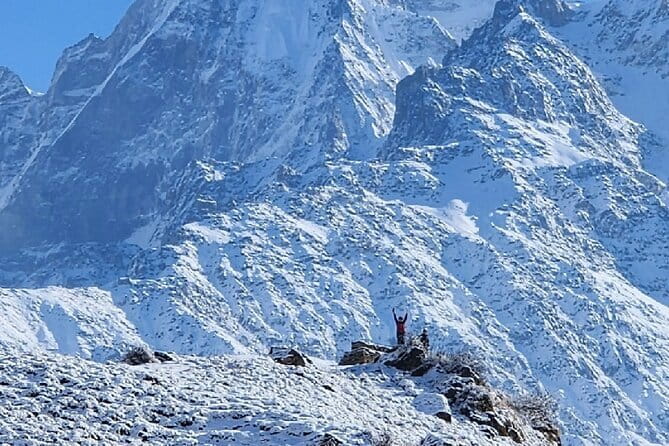
Seven days can buy a lot of mountain time. This trek pairs Mardi Himal Base Camp with quiet villages, alpine forest, and wide views of Fishtail, Annapurna South, and Hiunchuli. I like the clear route from Kathmandu to Pokhara, and I like that permits, meals, tea-house rooms, guide services, and transport are bundled into the $888 price. The main drawback is the steady altitude gain, especially the 4,450-meter base camp day, so you need a moderate level of fitness and a sensible pace.
I also like the cultural side of the walk. Dhampus and Pothana bring terrace farming, mountain homes, and local food into the trip, rather than making it only a high-altitude photo hunt. Guide Rajan, who is also the company founder, received warm praise for his friendly support and careful organization. Before booking, I would confirm the exact overnight plan, porter cost, and the Day 6 distance, since the published details describe that section in slightly different ways.
In This Review
- Key points to know before you book
- Why the Mardi Himal route works in seven days
- Day 1: The six-hour bus ride from Kathmandu to Pokhara
- Day 2: Kande to Forest Camp through village country
- Day 3: Forest Camp to Low Camp at 2,990 meters
- Day 4: Low Camp to High Camp and the first big views
- Day 5: The 4,450-meter Mardi Himal Base Camp day
- Day 6: A long descent to Badal Danda
- Day 7: Siding to Pokhara
- What the $888 price really covers
- The guide and private-trip advantage
- Fitness, altitude, and what to pack
- Who should book this trek
- Should you book the 7-day Mardi Himal Trek?
- FAQ
- Where does the Mardi Himal Trek start and finish?
- How high does the trek go?
- Is the trek suitable for beginners?
- Are meals included?
- Is a porter included?
- What happens if bad weather cancels the trek?
Key points to know before you book
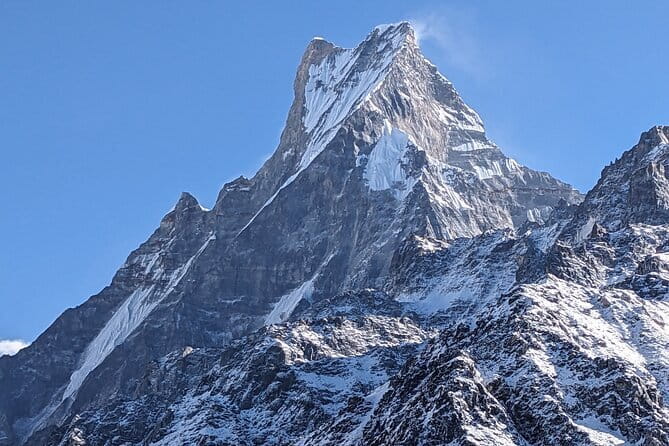
- Mardi Himal Base Camp reaches 4,450 meters, with close views toward Mardi Himal, Annapurna South, Hiunchuli, and Macchapucchre, also called Fishtail.
- The trek begins gently in the hills near Pokhara, then climbs through forest to Low Camp and High Camp.
- Dhampus and Pothana add local character, with terrace farms, village life, and mountain settlements along the route.
- The $888 price includes major trip costs, including Kathmandu to Pokhara bus travel, two Pokhara hotel nights, meals, permits, a guide, and tea-house accommodation.
- The route is moderately challenging, with several days of four to seven hours of walking and a high point above 4,400 meters.
- This is a private trip, so only your own group takes part, and dates and the itinerary can be adjusted to suit your plans.
Why the Mardi Himal route works in seven days
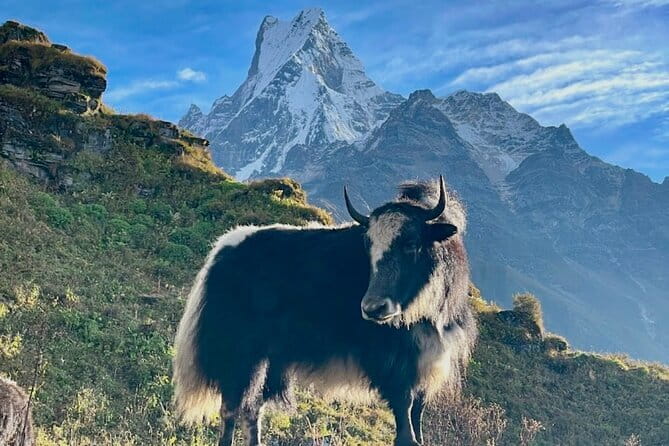
Mardi Himal is a good choice if you want a real Himalayan trek without committing to a much longer circuit. You get mountain views, forest walking, village contact, and a high base camp in one compact trip.
The route is also well shaped for variety. The opening walks pass through lower settlements and woodland. Later, the trees thin out and the mountains take over. That change gives each day a different feel, which helps keep a short trek from becoming repetitive.
The trip begins in Kathmandu but is designed to finish in Pokhara. That matters because Pokhara is the natural base for short treks in this part of Nepal, and the final return there gives you useful freedom after the walking ends. You can rest, continue to another destination, or make your own plans.
The private format is another plus. You are not tied to a large group’s pace, and the dates can be customized. That can be valuable on a route where weather, fitness, and acclimatization affect how quickly you want to walk.
More Mardi Himal treks:
- Mardi Himal Trek
★ 5.0 · 41 reviews - Mardi Himal Trek Nepal
★ 5.0 · 29 reviews - Pokhara: 4-Day Mardi Himal Trek
★ 4.9 · 59 reviews
Day 1: The six-hour bus ride from Kathmandu to Pokhara
Your first full day is mostly about reaching Pokhara. The company collects you from your hotel and transfers you to the tourist bus station, then you spend about six hours on the road.
This is not just dead travel time. The route passes hills, rivers, and countryside, giving you an early look at rural Nepal. Still, road travel in Nepal can be tiring, and the day is listed at about eight hours when transfers and stops are included. I would keep your schedule light after arrival.
Two nights in a deluxe tourist hotel in Pokhara are included, with breakfast and twin-sharing rooms. The published plan is not fully clear about how those nights are divided around the trek, so ask before booking. That simple question can prevent confusion about the night before the trail and the night after you return.
Day 2: Kande to Forest Camp through village country
After breakfast, a one-hour drive takes you from Pokhara to Kande, at 1,750 meters. This is where the walking begins.
The route climbs to Forest Camp at 2,550 meters over roughly four to six hours. You gain about 800 meters, which makes this a proper first trekking day rather than a casual stroll. I would use it to settle into your boots, walking rhythm, and pack weight.
This section introduces the character of the trek. Dhampus and Pothana are noted for their traditional mountain settlements, terrace farming, food, and local daily life. You get more than a line of pretty viewpoints. The villages help you see how people live on steep ground, where fields and homes occupy narrow shelves in the hills.
The night is in a tea house at Forest Camp. Accommodation on the trail is included, along with breakfast, lunch, dinner, and tea or coffee at breakfast. Tea-house lodging is practical rather than luxurious, so pack for simple rooms and basic mountain conditions.
Day 3: Forest Camp to Low Camp at 2,990 meters
Day 3 covers about three to four hours and gains another 440 meters. The destination is Low Camp, at 2,990 meters.
Compared with Day 2, the walking time is shorter, but altitude begins to matter more. You may find the forest especially pleasant here, with the route passing through alpine woodland and opening at points to views of the surrounding peaks and valleys.
This is a useful day for letting your body adjust. You do not need to race to the next lodge. A private guide can help set a pace that fits your group, and that is one of the practical benefits of taking this trip privately.
Low Camp is also where the mountain views begin to feel more immediate. The route is no longer only about village scenery and forest. You start to sense that the higher ridges are close ahead.
More walking in the hills of Kathmandu:
- Everest Base Camp Trek – 14 Days
★ 5.0 · 1,499 reviews - Everest Base Camp Trekking
★ 5.0 · 485 reviews - Nagarkot Sunrise View and Day Hiking from Kathmandu
★ 5.0 · 471 reviews - Annapurna Circuit Trek with Tilicho Lake
★ 5.0 · 368 reviews
Day 4: Low Camp to High Camp and the first big views
The walk from Low Camp to High Camp takes about four to six hours. The trail climbs 590 meters, reaching 3,580 meters.
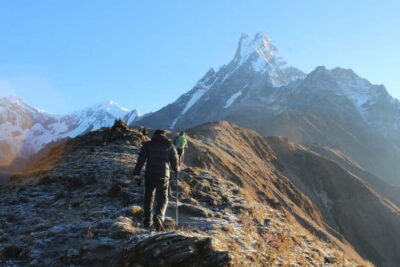
This is the day when Mardi Himal and Annapurna South begin to appear with greater force. Depending on conditions, you may see the route open toward the great peaks as the trees become less dominant. The combination of wooded slopes, deep valleys, and high summits is one of the trek’s strongest features.
High Camp is an important overnight stop because the following day is the hardest. The itinerary puts you within reach of the base camp, but it does not pretend the final push will be easy. You should treat this evening as a rest period, eat well, and prepare for a long out-and-back walk.
The cold and altitude can make High Camp feel demanding even before the next morning. The company provides meals and tea-house lodging, but personal expenses are not included, so keep some money available for anything extra you may want along the way.
Day 5: The 4,450-meter Mardi Himal Base Camp day
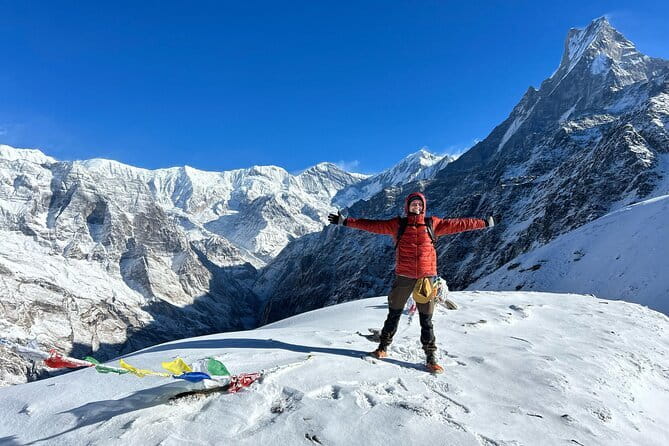
The base camp day is the main event. From High Camp, you walk to Mardi Himal Base Camp at about 4,450 meters, a six to seven-hour journey, then return to High Camp for the night.
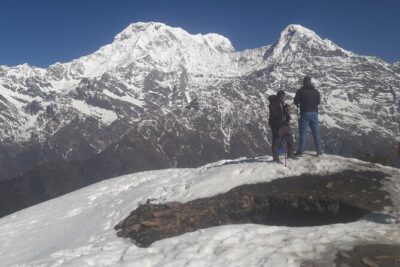
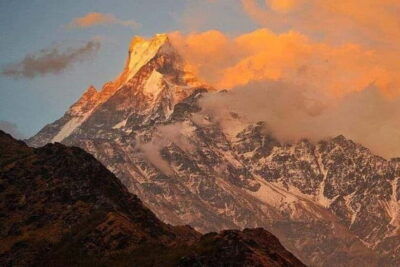
You are rewarded with views toward Mardi Himal, Annapurna South, Macchapucchre, and Hiunchuli. Fishtail is especially memorable from this route because of its sharp, distinctive shape. The setting also changes from forest and village country to a much more open high-mountain world.
The return to High Camp is important. This is not a simple one-way climb where you arrive and relax for the evening. You have to walk back after already spending several hours at altitude. For that reason, this day suits people who are comfortable with long mountain walks and who understand that altitude can slow even fit walkers.
The itinerary calls this a moderately challenging trek, which feels fair based on the hours and elevation. It is not presented as a technical climb, but the altitude is serious enough that you should not treat the day casually. Follow your guide’s advice, keep your pace even, and tell the guide promptly if you feel unwell.
Day 6: A long descent to Badal Danda
After breakfast and a slower morning, you descend from High Camp to Badal Danda at 3,300 meters. The walk is listed as about six to seven hours and 14 kilometers.
After the effort of base camp, this day gives your legs a different test. Descending can feel easier on your breathing, but it can be tough on knees and feet. Trekking poles may be useful, though they are not listed among the inclusions, so you should ask what equipment is available or bring your own.
I would confirm the exact route and distance for this day before departure. The information gives both a 14-kilometer figure and a six to seven-hour walking time, which may reflect the planned route rather than a strict measured distance. Your guide should explain the day’s stops and expected pace.
Badal Danda, at 3,300 meters, keeps you in the mountain zone for one more night. It is a sensible stopping point before the final walk down to Siding.
Day 7: Siding to Pokhara
The final walking section runs from Badal Danda to Siding. It is listed as 5.6 kilometers and about four to five hours.
This is a shorter distance than the base camp day, but you should not assume it will feel effortless. After several days on your feet, even a moderate descent can take time. The reward is the return to lower ground and the end of the trail portion of the trip.
From Siding, you drive to Pokhara. The tour ends there, giving you free time for your next plan. You can use that flexibility to stay on in Pokhara or continue onward, but any extra hotel night or activity in Pokhara is your own expense.
The end point is useful for travelers who do not need to return to Kathmandu immediately. If your international flight leaves from Kathmandu, remember that this package does not include the return journey from Pokhara.
What the $888 price really covers
At $888 per person, this is not a bare-bones walking package. The price includes the Kathmandu to Pokhara tourist bus, a private vehicle pickup from the airport or hotel if required, two nights of deluxe tourist hotel accommodation in Pokhara, and tea-house accommodation during the trek.
It also covers standard breakfast, lunch, and dinner during the trek. Breakfast includes a cup of tea or coffee, and the company handles the Annapurna Conservation Permit, TIMS fee, government taxes, and office service charge.
The licensed guide’s food, lodging, and related costs are included as well. A first-aid box with normal medical supplies and an oximeter is provided, which is a useful safeguard on a route that reaches 4,450 meters. A trekking route map is included too.
You pay separately for personal expenses, extra hotel nights and activities in Kathmandu or Pokhara, and a porter if you want one to carry your baggage. That last point deserves attention. If you prefer to walk with a light daypack, ask for the porter rate before you commit.
The value is strongest if you want one company to arrange the core pieces. You are not paying only for a guide and a trail bed. You are also covering permits, meals, intercity transport, and hotel nights. Still, compare the porter charge and clarify room arrangements before judging the price against other options.
The guide and private-trip advantage
The guide can make a major difference on a short trek. You have fewer spare days than on a longer route, so good timing and clear communication matter.
Rajan, the company founder, was specifically praised for being friendly and for keeping a five-day Mardi Himal trip well organized. The seven-day plan here follows a slower schedule, but that personal attention is still relevant. If Rajan is not your assigned guide, ask who will lead your group and what language support is available.
A private trip also gives you control over the day. You can discuss rest stops, walking speed, and any changes caused by weather. The company says dates and itineraries can be customized, which is useful if you need to add time in Pokhara or adjust the trek around other Nepal plans.
The tradeoff is that private travel can feel less social than joining a mixed group. If you want a built-in walking crowd, this format may not provide it. If you prefer your own pace and schedule, it is a strong fit.
Fitness, altitude, and what to pack
You need a moderate level of physical fitness. The walking days range from about three to seven hours, with the biggest climbs on Days 2, 4, and 5. The base camp day combines high altitude with a long out-and-back route, making it the key physical test.
Good preparation means regular walking before arrival, ideally with hills or stairs. You should also be comfortable carrying your personal daypack, since a porter is optional and not included.
Pack warm layers for High Camp and Base Camp, comfortable trekking shoes, rain protection, sun protection, and personal items. The supplied details do not specify a gear list, so ask the company for its current recommendations rather than guessing.
Weather matters. The company states that poor weather can lead to cancellation, with a different date or full refund offered. That policy is reassuring, but you should leave some flexibility in your Nepal schedule if possible.
Who should book this trek
I would recommend this trek to you if you want a short but serious Himalayan route, prefer private travel, and value having meals, permits, transport, and accommodation arranged in one price.
It suits people who want mountain views without spending weeks on a trail. It also works well for anyone who wants village life and forest walking alongside the higher peaks. The Dhampus and Pothana sections are especially useful if you want the trip to include more than mountain photos.
I would be cautious if you dislike long descents, basic tea-house accommodation, or uncertain mountain weather. The 4,450-meter base camp also deserves respect. You do not need technical climbing skills based on the information provided, but you do need stamina and a willingness to walk at altitude.
Should you book the 7-day Mardi Himal Trek?
Yes, if you want a well-priced private trek with a clear high point, strong mountain views, and useful inclusions. I especially like the balance between Pokhara comforts, village paths, forest, and the high ridge above 4,000 meters.
Before paying, ask three questions: Which two nights are in the Pokhara hotel, what is the porter charge, and what is the exact Day 6 route? If those answers suit your plans, the $888 price offers solid value for a seven-day Nepal adventure.
Free cancellation is available if you cancel at least 24 hours before the start time. Changes made inside that period are not accepted, and weather-related cancellations offer a new date or full refund.
FAQ
Where does the Mardi Himal Trek start and finish?
The trip starts in Kathmandu, with pickup from the listed meeting point or from your hotel if required. The trekking program finishes in Pokhara after the drive from Siding.
How high does the trek go?
Mardi Himal Base Camp is listed at approximately 4,450 meters. High Camp is at about 3,580 meters, and Low Camp is at about 2,990 meters.
Is the trek suitable for beginners?
The trek requires a moderate level of physical fitness. The route includes walking days of about three to seven hours, altitude gain, and a long base camp day, so you should be prepared for sustained uphill and downhill walking.
Are meals included?
Yes. Breakfast, lunch, and dinner are included during the trek. A cup of tea or coffee is included at breakfast.
Is a porter included?
No. A porter is available if you need one, but the cost is not included in the tour price.
What happens if bad weather cancels the trek?
If poor weather causes cancellation, you will be offered a different date or a full refund. For a standard cancellation, you must cancel at least 24 hours before the experience starts to receive a full refund.
New in the Kathmandu listings
- Traditional Momo Making Class★ 5.0 · 10 reviews
- Kathmandu: Ancient City Kirtipur & Pharping Monastery Tour★ 5.0 · 2 reviews
- Kathmandu to Pokhara Premium sofa bus ticket★ 4.0 · 17 reviews
- Women Empowerment Project(Nepali cooking class & jewelry workshop★ 5.0 · 15 reviews
- 7-Day Langtang Valley Trek from Kathmandu★ 5.0 · 1 review
- Kathmandu 2 Nights 3 Days Chitwan Jungle Safari Tour★ 5.0 · 9 reviews
- Yoga Experience Day Trip with Private Transfer From Kathmandu★ 4.0 · 2 reviews
- Wildlife Adventure in Chitwan Nepal★ 4.0 · 4 reviews
Mardi Himal Treks, compared.

Browse the lists this tour appears in